Orthodontist vs. Dentist: What’s Actually Different, and When You Need Which
A while back we took over treatment for a kid whose parents are both dentists. They had started the case themselves. At some point they looked at where it was heading, stopped, and called us. We were glad to take it and we got him where he needed to be.
I don’t tell that story to embarrass anybody. They made the right call, and honestly they made it earlier than most people do. I tell it because if two dentists can start a case and recognize partway through that it needs a specialist, that tells you how blurry this line has gotten for everyone else.
So here’s the actual difference, and the part of it that people in my profession don’t usually say out loud.
Is an orthodontist a dentist?
Yes. Every orthodontist is a dentist. Not every dentist is an orthodontist.
An orthodontist went to dental school first and holds the same degree a general dentist holds, either a DDS or a DMD. Then we did two to three more years in a full-time accredited orthodontic residency after that.
That residency is the whole difference. It isn’t a course you take on weekends while you keep seeing patients. You stop practicing, you go back to school, and you spend two or three years doing almost nothing but moving teeth and studying facial growth under supervision.
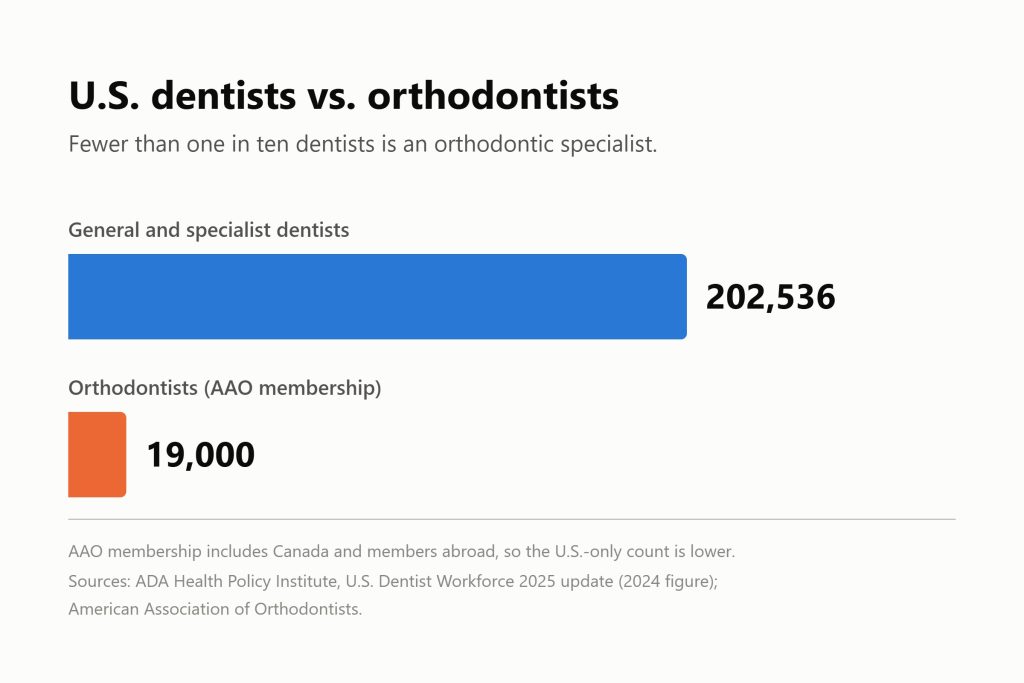
The numbers give you a sense of the scale. There are about 202,500 dentists in the United States, according to the ADA Health Policy Institute. The American Association of Orthodontists represents roughly 19,000 orthodontists, and that number includes Canada and members abroad. So orthodontists are somewhere under one in ten dentists, and the real US-only figure is thinner than that.
Are orthodontists doctors?
Yes, in the dental sense. Same DDS or DMD as your dentist, plus the specialty certificate, and often a master’s degree on top of it. We’re not physicians and we don’t hold an MD.
What is orthodontics, and what does an orthodontist do?
Orthodontics is the part of dentistry that deals with how teeth and jaws are positioned and how they fit together. General dentistry deals mostly with the health of individual teeth and gums. Orthodontics deals with the arrangement.
The short version people usually give is “we straighten teeth.” That’s not wrong, but it’s the least interesting part of the job and it’s the part that causes most of the confusion.
What we’re actually trained to manage is the bite. How the upper and lower jaws relate to each other. Whether the jaws are growing the way they should and what you can do about it while a kid is still growing. Whether the teeth are hitting in a pattern that’s going to wear them down or load them sideways for the next forty years. Where the roots end up sitting in the bone. What the airway and the tongue and the lips are doing.
Straight front teeth are one output of that. They’re not the goal.
Orthodontic services, if you want the practical list, cover braces, clear aligners, expanders, growth modification in children, retainers, planning extractions when they’re needed, and coordinating with an oral surgeon on cases where the jaws themselves have to move. Also fixing cases that didn’t go the way somebody hoped, which is a bigger part of the job than it used to be.
Do orthodontists pull teeth?
We decide whether teeth need to come out and which ones. We usually don’t do the extraction itself. That goes to your general dentist or an oral surgeon, and then you come back to us.
The decision is the specialist part. Whether a case needs extractions depends on how much room you’re short, where the roots can safely go, what the profile is going to look like at the end, and what happens to the bite either way. That call is made from a full set of records, not from looking at crowded front teeth and deciding they’re crowded.
In my practice, extractions run under five percent of cases. That is low, and it helps to know what it’s low against. At the University of North Carolina the extraction rate was 76% in 1968. By 1993 it was 28%, and by the mid-2000s some programs were down around 25%. In a recent survey of British orthodontists, 95.6% said they were extracting less than they did five or ten years ago. The whole specialty has moved this way.
It also depends a great deal on who you treat. Some patients have considerably more dental protrusion and crowding, or a skeletal pattern underneath it, and for them extraction is the honest answer rather than the aggressive one. Bimaxillary protrusion, where both the upper and lower front teeth sit forward, turns up in every population but is documented more often in African-American and Asian patients. In my own practice I see more extraction cases among Asian and Hispanic patients for that reason. That isn’t a rule about anybody. It’s just what the anatomy in front of me tends to be doing.
The part that has changed
Here’s the uncomfortable background to all of this.
In 2000 there were 55 dental schools in the United States. By 2020 there were 67. As of 2024 there are 73, and they enrolled just over 7,000 first-year students that year, a quarter of them at schools that didn’t exist a generation ago. The dentist population went from about 163,000 in 2001 to about 202,500 in 2024, and the ADA expects dentists per capita to keep climbing through 2040.
In a metroplex like ours, you feel that. There are a lot of good dentists competing for the same patients inside the same few square miles.
When a practice is under that kind of pressure, the math on referring a case out changes. Sending a patient down the street used to be routine. Now it’s revenue leaving the building, and there’s an entire industry built around making sure it doesn’t.
You can go look at what that industry sells. Six Month Smiles will certify a general dentist to provide clear aligners through a three-hour on-demand online course for $599. Their own site says no prior orthodontic experience is required. The in-person version is two days. As of the last practice survey I’ve seen, about 52% of general dentists provide some form of orthodontic treatment, and among those, clear aligners are the most common thing they offer.
Three hours against two to three years. I’m not going to pretend those are the same preparation.
The gatekeeper problem
Traditionally your dentist was the gatekeeper, and that system worked well. You saw your dentist twice a year, they caught the things that needed a specialist, and they sent you. That’s what a gatekeeper is supposed to do.
What I see more of now is the gate staying closed. Not out of malice. It’s just that the incentive runs the other way, and when the incentive runs the other way, a case that would have been referred out fifteen years ago gets kept and treated as something smaller than it is.
The version I run into most often is a patient with a genuinely traumatic bite who gets treated for minor alignment. The front teeth get straighter. The bite that’s doing the damage never gets addressed, and nobody ever told the patient it was there.
That’s the part that bothers me. Not that somebody treated a case they shouldn’t have. That the patient was never given the information to decide for themselves.
And when the gate does open, it doesn’t always open toward the right person.
A dentist near us told me once that I wasn’t sending enough cakes and cookies. He said other orthodontists were sending him gifts and he wanted to know why I didn’t. I didn’t say much in the moment. What I was thinking was that if he believed I was the right person for his patient, he should send them to me for that reason. My training, my results, how far the family has to drive. Not the cookies.
I don’t think he meant anything sinister by it, and a lot of that back and forth between offices is just normal professional courtesy. I bring it up because patients assume a referral is purely a clinical judgment, and it isn’t always only that. Sometimes it’s a preference, and the preference got formed somewhere you’ll never see.
So take the referral seriously, but take it as a starting point. You are allowed to ask your dentist why that orthodontist. You’re allowed to go get a second opinion from someone who isn’t on the list. We wrote more about that in private vs. corporate orthodontist, and why it matters after a dentist referral.
Where I actually land on this
An orthodontist’s job is to look at the whole bite, tell you plainly what’s going on with it, and lay out what can be done. Then you decide, based on what you actually want out of this.
Some patients hear the full picture and want the comprehensive correction. Some hear it and say they only care about the front six and they understand what they’re leaving on the table. Both of those are legitimate answers. I’ve treated plenty of limited cases for patients who made that choice with their eyes open.
But it’s only a real choice if the patient understands how their bite functions. If nobody explains that, the patient didn’t choose the limited treatment. They just got it.
To be fair to general dentists
Plenty of orthodontic treatment in general practices comes out fine. Mild crowding. Minor relapse in an adult who had braces in high school and stopped wearing the retainer. A patient who wants their front teeth tidied up and has a bite that’s fundamentally healthy underneath. Those cases are appropriate, and a dentist who has trained seriously and knows where the edges of their skill are can do good work on them.
The trouble isn’t dentists doing orthodontics. It’s cases getting sorted by who’s holding the patient rather than by what the case actually needs.
How to tell whether you need an orthodontist
A few things worth asking, whoever you’re sitting in front of:
Are you a specialist? Just ask directly. “Did you complete an orthodontic residency, and where?” It is a completely normal question and nobody good is offended by it. A dentist who does orthodontics is not an orthodontist, and the marketing language on a website often blurs that on purpose.
What’s the plan for my bite, not just my teeth? If the answer is only about how the front teeth will look, you have your answer about how deep the workup went.
What are the full records? A real orthodontic diagnosis involves a panoramic X-ray, usually a cephalometric X-ray or a 3D scan, photos, and a scan or impression of the bite. If nobody’s looking at the bone and the roots, nobody’s diagnosing anything.
What are the other options, including the ones you don’t provide? The answer to this tells you a lot.
What happens if this doesn’t get us there? Every honest treatment plan has an answer to that question.
If you want the longer version of this, we put it together as a practical checklist for choosing an orthodontist.
What happens at your first orthodontist appointment
Usually less than people expect. You come in, we take the records, we look at everything, and we tell you what we see. In children we’re checking whether the permanent teeth have room to come in and whether the jaws are growing evenly, which is why the recommendation is to have a kid evaluated around age seven, well before anyone would actually put braces on.
Sometimes the honest answer at that visit is that nothing needs to be done yet, or at all. That’s a normal outcome and you should be told it plainly when it’s true.
Nothing gets put on your teeth that day, and you shouldn’t feel like you have to decide anything before you leave.
The one thing worth remembering
If you take one thing from this: straight teeth and a healthy bite are not the same thing, and only one of them is visible in the mirror. Whoever you see, make them explain the second one.