Private vs Corporate Orthodontist: Why It Matters (Especially After a Dentist Referral)
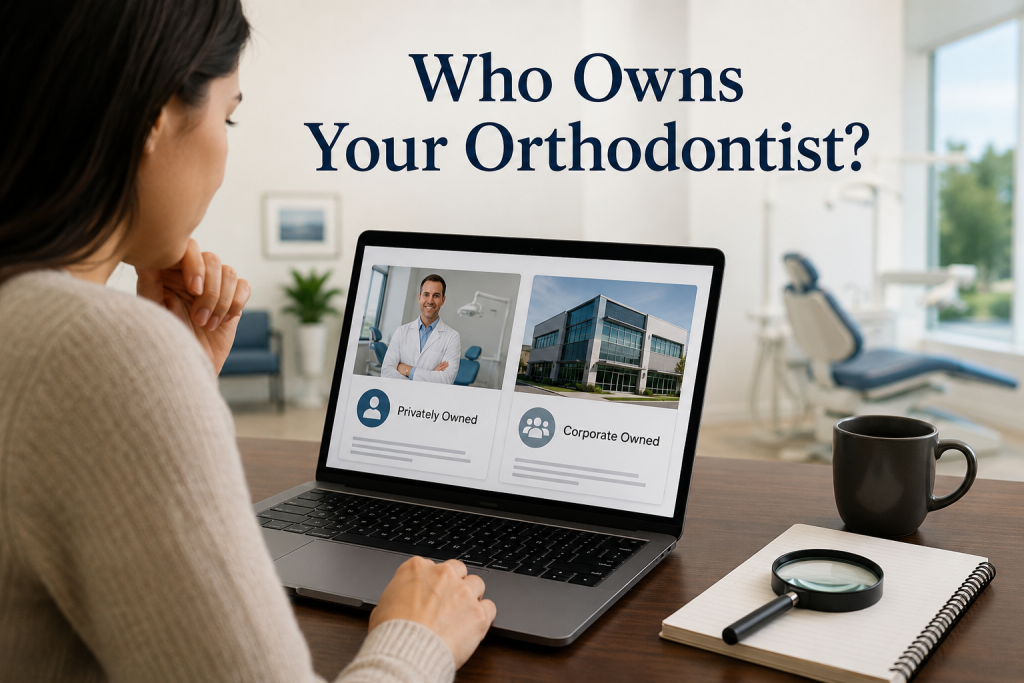
When your dentist refers you to an orthodontist, that referral usually says nothing about who owns the practice. Some offices are owned by the orthodontist who treats you. Others are run by corporate groups or dental support organizations. Both can deliver great care, but ownership quietly shapes things like who actually treats you, how consistent your care is, and how decisions get made. This post explains the difference, why a referral is exactly the moment to check, and how to look it up before your first appointment.
The referral nobody questions
Here is how it usually goes. You are at a routine cleaning, your dentist notices some crowding or a bite issue, and they hand you a name. “Go see this orthodontist.” Most people take the slip, book the appointment, and never think twice. The referral feels like a recommendation, so it carries weight.
The thing worth knowing is that a referral tells you where to go, not who owns the place. Your dentist may genuinely rate that orthodontist. But referrals can also follow other patterns. Some practices share ownership or referral arrangements. Some dentists simply send patients to whoever is closest or most familiar. None of that is sinister, and your dentist may not even think the ownership question is relevant. But it means the name on the slip is a starting point, not the final answer.
Worth knowing: A referral is a great reason to look someone up, not a reason to skip looking. You are still the one committing to one to three years of treatment, so a few minutes of checking is more than fair.
Private vs corporate: the real difference
Orthodontic practices are not all structured the same way, and the structure is not usually advertised on the door. Broadly, there are two models.
Owned by the orthodontist who treats you, or a small partner group. The person making clinical decisions usually has a direct stake in the practice and tends to be the one you see at each visit.
Part of a larger group or dental support organization that may run many locations. Doctors are often employees, and some business decisions are set at the group level rather than in the chair.
Neither model is automatically better. There are excellent privately owned practices and excellent corporate ones, and plenty of patients are perfectly happy with either. The point is not to avoid one type. It is to know which one you are walking into, because the model can shape your day-to-day experience in ways that are easy to miss until you are already in treatment.
Why it matters for your treatment
Orthodontic treatment is long. You will be back many times over many months, and small differences in how a practice runs add up. A few things ownership can quietly influence:
- Who you see. In some larger groups the treating doctor can change between visits, or much of the routine work is handled by assistants. Continuity matters when one person is tracking how your teeth move over time.
- How decisions get made. When the owner is also the treating doctor, clinical and business calls sit with the same person. In a group model, some choices may follow company-wide policies.
- Pricing and sales pressure. Any practice can be transparent or pushy. Knowing the model helps you read whether a hard upsell is the doctor’s call or a standard playbook.
- Continuity if staff change. If your provider leaves, an owner-operated office and a multi-location group handle that handoff very differently.
Again, none of these are automatic problems. A great corporate office can offer rock-solid continuity and a privately owned one can have its own quirks. The value is in knowing the model so you can ask the right questions instead of finding out halfway through treatment.
What to ask either kind of office
You do not need to interrogate anyone. A few plain questions at the consultation tell you most of what you want to know.
- Who owns this practice, and is the orthodontist I am meeting today an owner or an employee?
- Will I see the same orthodontist at every visit, or could that change?
- Who handles the routine adjustments, the orthodontist or an assistant?
- If my doctor leaves during treatment, what happens to my care and my plan?
- Is the quoted fee set here, or does it follow a company-wide pricing structure?
Clear, relaxed answers are a good sign. A practice that is comfortable telling you how it is structured is usually comfortable telling you everything else too.
How to check before you go
This is the part most directories skip. Google, Yelp, and even the official specialty listings will tell you a practice’s name, address, and reviews, but not who owns it. You can spend a long time digging through corporate websites and ownership records trying to piece it together yourself.
Our approach: OrthodontistNearMe labels each practice as privately owned or corporate owned, right on the listing. So when your dentist hands you a name, you can look it up here in a minute and walk into that first appointment already knowing what kind of practice you are dealing with.
That is the whole idea behind the directory. Not to steer you toward one model, but to put the information in front of you that everyone else leaves out, so the choice is actually yours.
Your next step
Got a referral in hand? Look the practice up before you book, note whether it is private or corporate, and bring a couple of questions to the consultation. A confident choice beats a convenient one, especially for treatment that lasts this long.
Search orthodontists near you and see which are privately owned vs corporate.
Search orthodontists near me →Are you an orthodontist? Add your practice to the directory →
This article is general information, not medical advice.