What Age Should a Child First See an Orthodontist? The Truth About Age 7
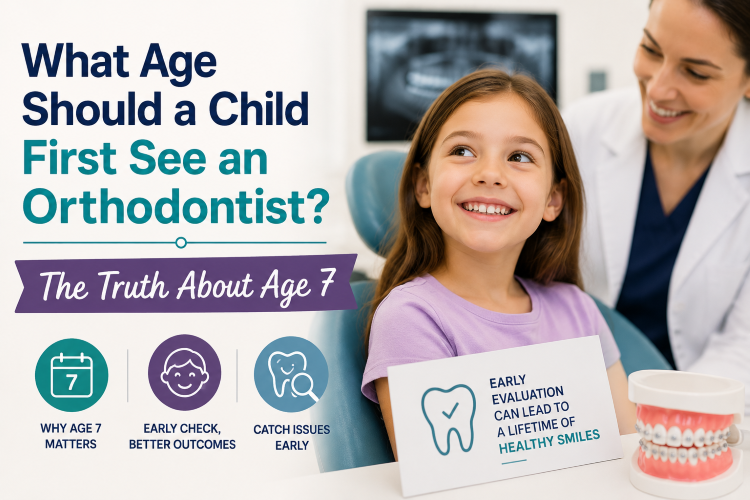
The American Association of Orthodontists recommends that every child have a first orthodontic check-up by age seven. That surprises a lot of parents, since most kids still have baby teeth at that age. The point is not to start braces early. It is to catch the small number of problems that are far easier to guide while a child is still growing. For most kids, the visit ends with a simple “check back later.” This guide explains why age seven, what early treatment does and does not do, and the signs worth watching for.
Why age seven?
By around age seven, a child usually has enough permanent teeth coming in, especially the first molars and incisors, for an orthodontist to see how the bite is developing. That is early enough to spot problems while the jaw is still growing and flexible, but not so early that nothing can be evaluated yet. It is a window, not a deadline. The goal of that first check is simply to get eyes on the bite and flag anything that benefits from timing.
It helps to know that this is a screening, not a sales pitch for braces. Most seven-year-olds who get checked do not need any treatment at that point. The orthodontist takes a look, notes how things are tracking, and in the great majority of cases recommends monitoring and a follow-up in a year or two. The value is in catching the rare case early, not in starting hardware on a first grader.
What happens at the first visit
A first orthodontic visit for a young child is quick and low pressure. The orthodontist looks at how the teeth are erupting, how the top and bottom jaws meet, and whether there is enough room for the permanent teeth still on the way. Many practices offer this initial evaluation at no charge, so it costs a parent little more than time.
From there, one of three things happens. Usually the answer is that everything looks fine and the child should simply be rechecked periodically as they grow. Sometimes the orthodontist recommends a short, targeted phase of early treatment for a specific reason. Occasionally there is a clear issue that still should wait until more permanent teeth arrive. All three outcomes are normal, and a trustworthy orthodontist will tell you plainly which one applies rather than pushing treatment you do not need.
Worth knowing: An early check-up does not mean early braces. For most children the visit ends with monitoring, not treatment. The rare cases where acting early truly helps are exactly why the age-seven check exists.
What early treatment can and cannot do
When early treatment is recommended, it is usually because a child is still growing and that growth can be used to fix something that gets much harder to address later. Guiding the width of a narrow upper jaw, creating room for crowded teeth, correcting a crossbite, or addressing a habit that is pushing teeth out of place are the kinds of problems where timing genuinely matters. Done at the right moment, a short early phase can make later treatment simpler or, in some cases, unnecessary.
What early treatment cannot do is straighten every tooth once and for all before the permanent teeth have arrived. It is not a shortcut that skips regular braces for most kids, and starting too early on the wrong case just means more time in appliances for no added benefit. The honest version is that early treatment is powerful for a small group of children and unnecessary for the majority, which is why the evaluation matters more than any fixed rule about starting.
When waiting is the right call
For plenty of children, the best plan after an age-seven check is to do nothing yet. If the bite is developing normally and any crowding is mild, there is no advantage to starting early, and treating too soon can mean a longer overall process. In these cases the orthodontist keeps an eye on things through periodic recheck visits and starts treatment later, usually in the early teens, once most permanent teeth are in and the timing is efficient.
Waiting is not the same as ignoring. The point of the early visit is to know which camp your child is in: the small group who benefit from acting now, or the larger group who are better served by watchful waiting. Either way, you leave with a plan instead of a guess.
Signs worth watching for
- Early or very late loss of baby teeth, or teeth erupting well out of the normal order.
- Difficulty chewing or biting, or teeth that do not meet properly when the mouth closes.
- Mouth breathing, or thumb or finger sucking that continues past the early years.
- Jaws that shift, click, or clearly do not line up front to back or side to side.
- Crowding that is already obvious, or front teeth that stick out or bite in the wrong place.
- Speech difficulties that seem tied to how the teeth or jaws are positioned.
Any of these is a reasonable reason to book an evaluation, even if your child is not yet seven. None of them automatically means braces are coming. They are simply cues that a professional look is worthwhile.
Your next step
If your child is around seven, or if you have noticed any of the signs above, an initial evaluation is a low-cost, low-pressure way to get answers. Since the first consultation is often free, it is worth seeing more than one orthodontist if a treatment plan is proposed, so you can compare recommendations. For help sizing up a practice, see our checklist for choosing an orthodontist.
Find and compare orthodontists near you, including which practices are board certified and independently owned, so your child’s first visit is with someone you trust.
Search orthodontists near me →This article is general information, not medical or dental advice. Every child develops differently; always confirm what is right for your child with a licensed orthodontist.