Privately Owned Orthodontists in Dallas: The 2026 List by Zip
★ The short version
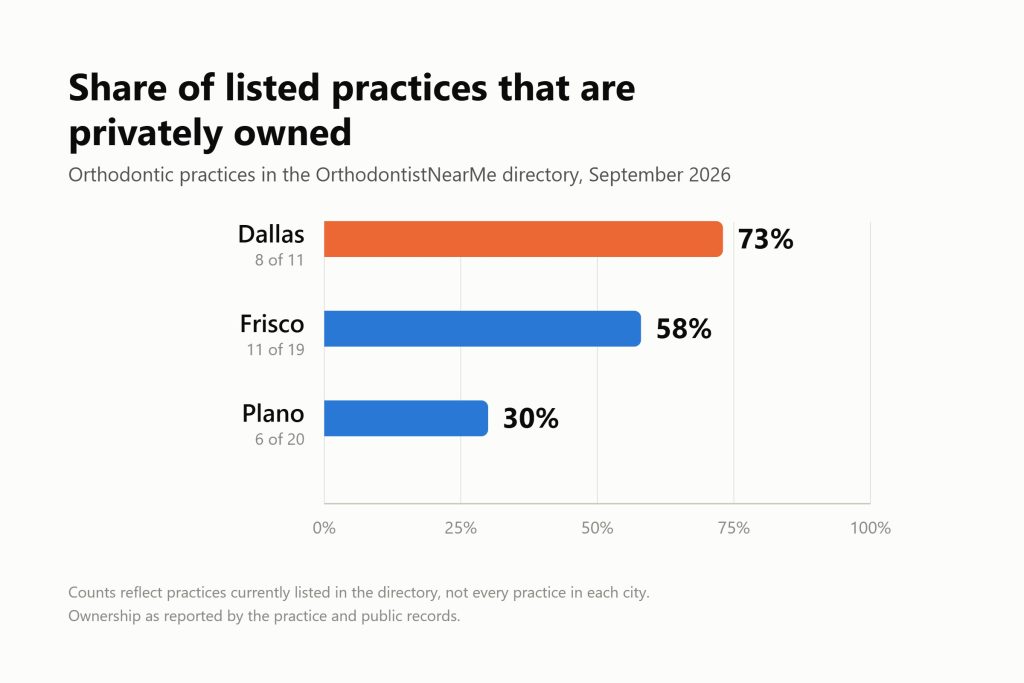
- Eight of the eleven Dallas orthodontic practices in our directory are privately owned. That is 73%, and it is the highest private share of any city we cover well.
- Plano, twenty minutes north, runs the other way: 6 of 20, about 30%. Same metro, opposite ownership mix.
- Below is every privately owned Dallas practice we list, grouped by zip code, with addresses.
- This is what we have listed, not a census of every orthodontist in Dallas. We are still adding practices.
- Ownership here means ownership as reported by the practice and by public records. It is information, not a verdict on quality.
Dallas is the most independently owned orthodontic market we have data on, and it is not particularly close.
Eight of the eleven Dallas practices in our directory are owned by the orthodontist who works there. Drive up to Plano and the number flips: six of twenty. Two cities in the same metro, forty minutes apart, with almost opposite ownership structures.
We do not have a tidy explanation for that. What we can do is show you who is who, which is the part that is usually impossible to find.
Privately owned orthodontists in Dallas, by zip code
Every practice below is listed in our directory as privately owned, meaning the practice reports that an orthodontist owns it rather than a dental support organization, a corporate group, or an outside investor.
75205 (Park Cities)
- Define Orthodontics (Park Cities), 7015 Snider Plaza #200
75206 (Lakewood / Lower Greenville)
- Lakewood Orthodontics, 1931 Skillman St
75208 (Bishop Arts / North Oak Cliff)
- Gupta Smile Studio, 1222 N Bishop Ave, Suite 600
75214 (Mockingbird / East Dallas)
- Ellis Orthodontics, 6333 E Mockingbird Ln #275
75225 (Preston Hollow / University Park)
- University Park Orthodontics, 6128 Sherry Lane
75230 (North Dallas)
- Orthodontic Specialists of Dallas, 7859 Walnut Hill Ln, Suite 275
- Ohlenforst Carney Orthodontics, 5925 Forest Lane, Suite 400, Floor 4
75252 (Far North Dallas)
- Fusion Orthodontics, 19200 Preston Rd #100
What the Dallas pattern looks like on a map
The private practices cluster inside the loop and along the older north corridor. Park Cities, Lakewood, Bishop Arts, Mockingbird, Preston Hollow. These are established neighborhoods with established practices, and 75230 is the only zip on the list with more than one.
That is a different shape from the suburbs. In Frisco and Plano the practices sit in newer retail and medical developments along the big arterials, and the corporate groups are heavily represented there. Newer rooftops, newer practices, and newer practices are the ones most likely to have been bought or opened by a group.
Again, that is an observation about our data, not a law of the universe. But it is consistent enough across the metro to be worth noticing when you are choosing where to go.
What “privately owned” actually means here
It means the practice reports that an orthodontist owns it. Not a dental support organization, not a corporate platform, not a private equity partner.
It does not mean the practice is better. Plenty of corporate-affiliated offices are run by excellent orthodontists, and plenty of independent offices are ordinary. Ownership tells you who makes the decisions about scheduling, staffing, materials, and how long an appointment runs. It does not tell you how good the clinician is.
We publish it because it is nearly impossible to find otherwise, not because one answer is right. Ownership is information, not a verdict.
Where this comes from, and what it is not
Ownership on each listing comes from the practice itself and from public records. Where a practice tells us it is independently owned, that is what we show, and we say on the listing that it is as reported.
The important limit: eleven practices is not every orthodontist in Dallas. It is every Dallas orthodontist currently in our directory. The real number of practices in the city is larger, and we are still adding. So read the 73% as a statement about what we have verified so far, not as a market census.
If your practice is missing, or the ownership on your listing is wrong, tell us and we will fix it.
How to check any practice yourself
You do not have to take our word for it, and honestly you should not take anyone’s word for it on this.
Look at the bottom of the website. A corporate group usually appears in the footer, in the privacy policy, or in the terms. It is rarely on the home page.
Search the practice name with the word “partners” or “group.” Acquisition announcements are public and the groups put out press releases when they buy a practice.
Ask at the consult. “Who owns this practice?” is a normal question and a straight answer takes five seconds. We wrote a longer version of this in how to tell whether your local orthodontist is corporate owned.
And if what you actually want to know is whether you need an orthodontist at all rather than a dentist who does orthodontics, that is a separate question we covered here.
Updated September 2026.