
Follow the Money: Who Funds the AAO Now?
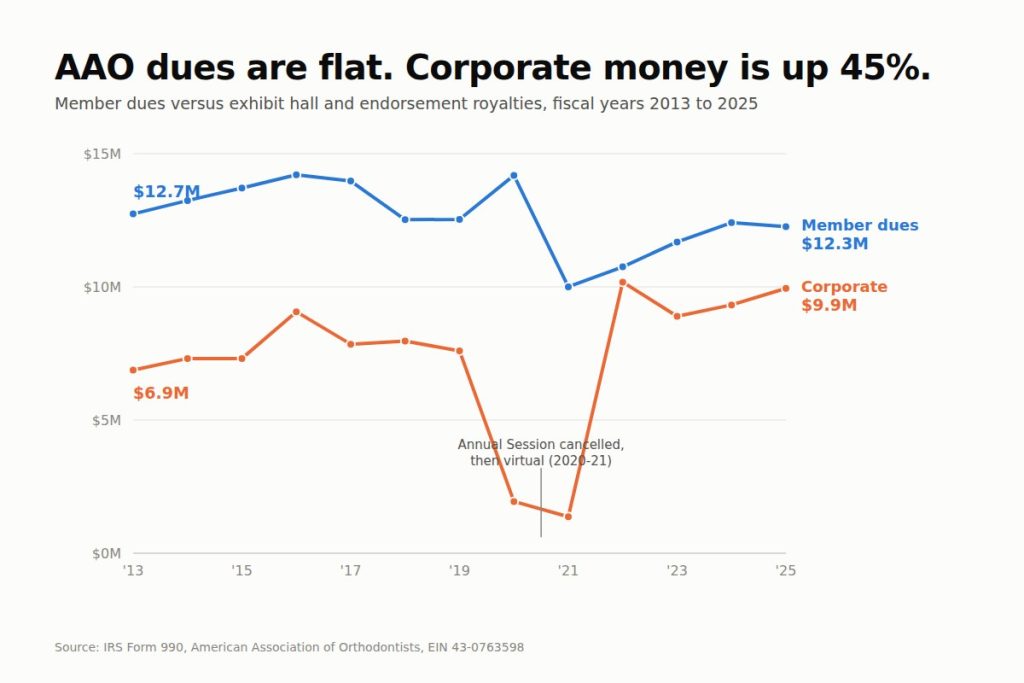
Member dues used to dwarf the AAO’s commercial revenue. That gap has narrowed considerably. At the same time, more orthodontists are working for corporate organizations.
- AAO member dues were $12.7 million in 2013. In 2025, they were $12.3 million. That’s actually lower in nominal dollars, twelve years later.
- Exhibit hall revenue plus endorsement royalties grew from $6.9 million to $9.9 million over the same period, an increase of roughly 45%.
- In 2018, 6% of AAO members worked in DSO or OSO settings. By 2023, it was 14%. Among members under 35, it was 28%.
- Some corporate employers also pay AAO membership dues for their orthodontists, meaning even part of the “member dues” line may ultimately come from employers.
- AAO-endorsed companies can pay the association a royalty based on sales to AAO members, in addition to advertising and exhibiting requirements.
- I looked for evidence that the AAO was simply wasting the money. I didn’t find it. Executive compensation is relatively modest compared with peer associations, and there are reasonable explanations for much of its spending.
- So this isn’t really a story about whether the AAO manages money well. It’s about who increasingly funds the organization, who increasingly employs its members, and whether that changes who the AAO ultimately represents.
I started with two columns
I wasn’t looking for a scandal.
I wanted to understand something much simpler:
Who funds the AAO today?
The American Association of Orthodontists is a nonprofit, so its IRS filings are public.
I pulled the numbers.
And two columns caught my attention.
| Fiscal year | Member dues | Exhibit hall + endorsement royalties |
|---|---|---|
| 2013 | $12,737,433 | $6,875,219 |
| 2015 | $13,711,354 | $7,311,176 |
| 2017 | $13,972,080 | $7,848,214 |
| 2019 | $12,534,171 | $7,598,283 |
| 2023 | $11,686,343 | $8,892,732 |
| 2024 | $12,410,960 | $9,322,212 |
| 2025 | $12,259,060 | $9,944,935 |
In 2013, dues exceeded those commercial revenue categories by almost $6 million.
By 2025, the gap was about $2.3 million.
And look at the dues themselves.
2013: $12.74 million.
2025: $12.26 million.
Twelve years later, member dues were lower in actual dollars.
Meanwhile, exhibit hall revenue plus endorsement royalties increased by roughly 45%.
That doesn’t prove corporate influence.
But it tells us where to keep looking.
The specialty changed at the same time
The other numbers come from the AAO itself.
In 2018, about 6% of AAO members worked in a DSO or OSO setting.
By 2023: 14%.
Among AAO members younger than 35: 28%.
That’s a significant change in five years.
And it creates an interesting dynamic.
Historically, the AAO’s financial relationship was relatively straightforward:
Orthodontist → dues → AAO.
Today, there are increasingly other relationships around that transaction.
A corporation may employ the orthodontist.
The corporation may pay the orthodontist’s AAO dues.
The corporation may advertise with the AAO.
It may exhibit at Annual Session.
It may sponsor AAO programming.
And companies selling products and services to orthodontists can also pay the AAO royalties.
The ecosystem has changed.
Even some “member dues” may come from corporations
Take Smile Doctors.
Its orthodontist job postings have included:
“C.E. Allowance & AAO Dues Paid”
Nothing is wrong with that.
Employers pay professional dues all the time.
But it creates an accounting wrinkle.
The IRS filing calls that money member dues.
Economically, the check may have come from the member’s corporate employer.
How much of the AAO’s dues revenue is actually employer-paid?
I don’t know.
I couldn’t find a published number.
And I don’t think we should estimate it without better data.
But as more orthodontists become employees, it becomes a more relevant question:
Who is actually paying for AAO membership?
Then there are the companies selling to us
Annual Session is a major commercial event.
Companies buy booths, sponsorships and advertising.
Again, completely normal.
The AAO even publishes how its priority system works.
For the 2026 Annual Session:
“1 priority point is worth roughly $2500 in sponsorship & advertising dollars.”
More financial engagement can help companies select exhibit space earlier.
I checked other professional organizations.
They do similar things.
So I don’t see a scandal there.
It’s a trade show.
Trade shows sell access.
Endorsements are different
This relationship deserves more attention.
The AAO allows selected companies to use the “AAO Endorsed” logo.
What I didn’t know was how the financial side worked.
The AAO tells potential partners:
“Royalty paid to AAO for license of ‘AAO Endorsed by logo,’ typically calculated as a percentage of sales to AAO members.”
There is also a minimum AAO advertising commitment and an Annual Session exhibit requirement.
That means, at least under the typical arrangement the AAO describes, when members buy more from an endorsed company, the AAO can make more money.
That doesn’t mean the endorsement is illegitimate.
But it creates an obvious incentive worth understanding.
What percentage does the AAO receive?
I couldn’t find it publicly.
What evidence does a company have to provide before receiving an AAO endorsement?
That’s where things get much more interesting.
I’ll get into that in Article 2.
Is the AAO wasting all this money?
I looked.
That would have been an easy article.
It just isn’t what the evidence showed me.
AAO executive compensation appears relatively modest compared with several peer dental associations.
Board members are compensated, but they also report substantial time commitments, and their implied hourly compensation isn’t extraordinary for practicing orthodontists.
There are expenses I would like explained more clearly, but I didn’t find evidence supporting a simple narrative that the AAO is recklessly burning through orthodontists’ money.
So I don’t think that’s the important story.
The revenue side is much more interesting.
Follow the relationships
Put everything together.
Commercial revenue has grown.
Corporate employment of orthodontists has grown.
Some corporate employers pay AAO dues.
Companies pay for exhibit space, advertising and sponsorships.
Endorsed companies can pay royalties tied to purchases by AAO members.
And, as we’ll see in the next article, the AAO has gone another step:
It invests in orthodontic companies itself.
None of those things individually proves that corporations control the AAO.
I haven’t found evidence supporting that claim.
But they do show something important.
The AAO of 2026 operates in a very different orthodontic economy than the AAO of 2013.
And that raises the question I care about much more than whether somebody’s hotel room cost too much:
Who does the AAO represent now?
Individual orthodontists?
Independent practice owners?
Employed orthodontists?
The corporations employing them?
Companies selling to them?
All of the above?
Maybe the answer is all of the above.
But those groups don’t always have the same interests.
An independent orthodontist negotiating against a DSO does not necessarily have the same priorities as the DSO.
A company selling a product does not necessarily have the same interests as the orthodontist buying it.
And an organization receiving money from both sides has to navigate those differences.
That’s why transparency matters.
I am no longer an AAO member. Their priorities do not have to be mine.
But the AAO continues to speak for the specialty, educate orthodontists and residents, advocate on behalf of orthodontics, endorse companies, host its largest commercial gathering and increasingly interact with the organizations employing orthodontists.
So I think a few questions are fair:
What percentage of AAO dues is actually paid by employers?
How much of AAO revenue ultimately comes from companies that sell to or employ orthodontists?
And as that financial relationship grows, what safeguards make sure the orthodontist remains the person the organization ultimately represents?
I don’t know the answers.
That’s why I’m asking.
About this series
This series is based on public IRS filings, AAO-published materials and primary company sources. When something is my calculation, interpretation or opinion, I will say so.
If I get a fact wrong, send me the source. I’ll correct it and mark the correction.
And if the AAO believes something here is missing important context, I will publish its response.
I’d rather have the answer than the argument.
Next in this series
Investor. Endorser. Award-Giver. When the AAO Does All Three.
In the meantime, see what one state just decided about who is allowed to own an orthodontic practice.