Dental Autopilot and the Shift From Marketing Agencies to AI Agents
Disclosure first: I founded Dental Autopilot. I also own this directory and White Glove Orthodontist, which runs a small marketing agency. Read this with that in mind.
I paid a well-known dental website and SEO company for five years. Every month there was a report. Charts, keyword positions, a lot of green arrows. What it never told me was whether the phone rang more because of anything they did.
Eventually I decided to learn it myself. Local SEO, Google Business Profile, map rankings, the technical side of the websites. Once I was doing it, the results got a lot better.
The problem is that doing it myself takes time I don’t have. I run several offices and I’m in clinic most days. So I built something that does the daily work the way I would do it, inside my own accounts, every day. That became Dental Autopilot.
★ The short version
- Practices are spending more on marketing and trusting it less. Average satisfaction in MouthWatch’s 2026 survey fell to 6.21 out of 10.
- Most of what frustrates doctors about agencies is built into the agency business model: divided attention, activity-based reporting, ads covering weak fundamentals, and accounts held in the agency’s name.
- An AI marketing agent does the repetitive daily work (review replies, posts, map tracking, page fixes) inside the practice’s own accounts, for a fraction of agency pricing.
- Dental Autopilot starts at $249 a month for the first office. I own it, so weigh that accordingly.
- Whatever you use, the test is the same: who owns the accounts, can you see every change, and is it measured in phone calls.
Practices are paying more and trusting it less
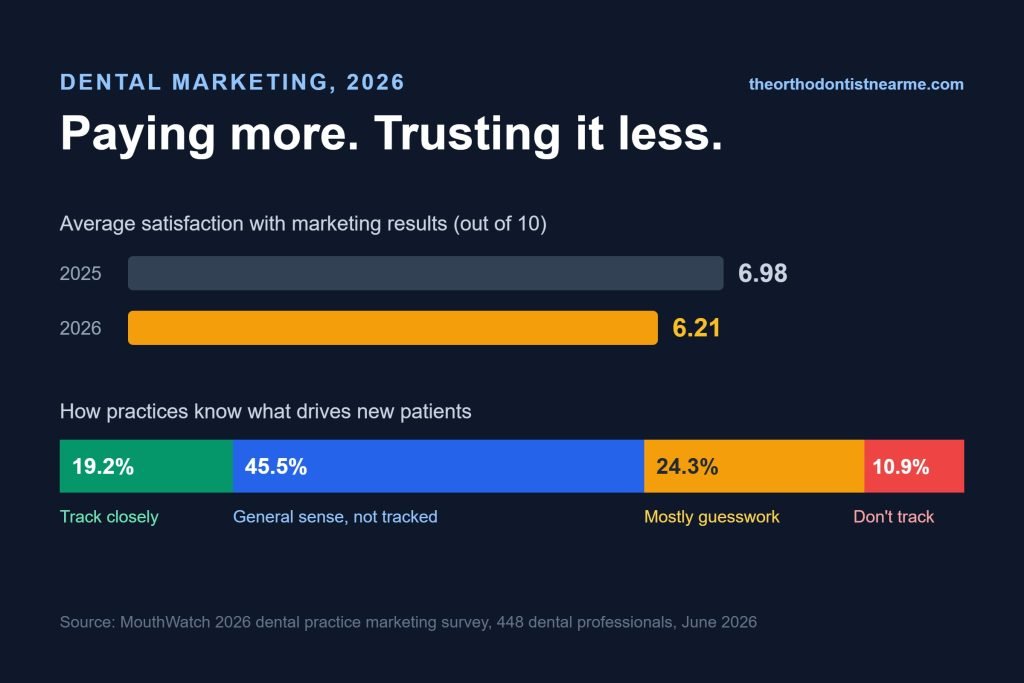
MouthWatch surveyed 448 dental professionals in June 2026. Average satisfaction with marketing results was 6.21 out of 10, down from 6.98 the year before. Only 19.2% said they track what drives new patients closely. Another 24.3% called it mostly guesswork, and 10.9% don’t track at all. (MouthWatch, 2026)
So roughly a third of practices are either guessing or not looking.
DentalPost found that 59% of practices rely on their front office team to handle marketing, including advertising and SEO. Practices that bring in outside marketing help spend an average of 3.55% of collections on marketing, versus 2.2% for practices without an agency or consultant. (DentalPost)
On a practice collecting $1.5 million, that’s about $53,000 a year versus $33,000. Those are survey averages, not a controlled comparison, but it gives you a sense of the scale.
To be fair, MouthWatch did find satisfaction rises with spend. Practices spending nothing averaged 5.7. Practices spending $5,000 or more a month averaged around 7. Spending more helps a little. Paying $60,000 a year to feel 7 out of 10 about it is not a great trade.
What’s actually wrong with the agency model
I don’t think agencies are full of bad people. Most of the problems are structural. They come from how the business makes money.
I’m not saying that only as a former customer. White Glove Orthodontist also runs a small agency that does hands-on digital marketing for practices. So I know how it works on the back end. Ours is low volume, a small number of offices, and at that size it’s manageable. With the bigger agencies, I think everything below is just a matter of time. Each new client adds work without adding attention, and eventually something gives.
Attention divides as the agency grows
An agency grows by adding clients. Each new practice gets a slice of the same team. An account manager with a full book can’t look at your Google profile every day, and nobody is paying them to.
An agent works the other way. The more practices it runs, the more it learns about what actually drives patient calls, and it still looks at your office every day.
You’re paying for their overhead
Account managers, project managers, a sales team, the people who sold you the contract. That’s all in the fee. And a lot of agencies already use AI to write content and generate images. A higher fee doesn’t necessarily mean a person wrote the blog post.
Reports measure activity, not patients
Impressions, rankings for keywords nobody searches, “leads.” The report looks busy. What I wanted to know was simpler: which offices, pages and sources made the phone ring, and did those calls turn into starts. My agency reports never connected to phone calls.
Ads get used to cover weak fundamentals
When results lag, the easy answer is a bigger ad budget. Ads work. But ad traffic is rented. It lasts exactly as long as you keep paying. Rankings, reviews and a well-maintained Google profile keep working after you stop writing checks. I made the same argument about the AAO’s own budget in The AAO Pays Google More in a Month Than It Pays Its Federal Lobbyists All Year. The logic doesn’t change when it’s your practice.
The accounts aren’t always yours
This one surprises a lot of doctors. Websites, domains and Google Business Profiles sometimes get set up in the agency’s name. A Google Business Profile has one primary owner, and only the primary owner can transfer it. If that’s the agency, leaving gets complicated. Add a long contract and you can feel stuck with a vendor you stopped trusting a year ago.
It takes two minutes to check. Open your Business Profile, go to Business Profile settings, then People and access, and see whose name is next to Primary owner.
Small changes take a ticket and a week
Updating hours, swapping a photo, fixing a page title. None of it is hard. It just sits in a queue.
| Typical agency | AI marketing agent | |
|---|---|---|
| Attention | Split across a growing client list | Every office, every day |
| Reporting | Monthly report, impressions and rankings | Every action in a readable log, tied to calls |
| Growth lever | Ad budget | Rankings, reviews, Maps; ads only as a capped top-up |
| Accounts | Sometimes held in the agency’s name | Stay in the practice’s name |
| Changes | Ticket, about a week | Asked in plain words, done the same day |
| Contract | Often long term | Month to month |
Agents, not agencies
An AI tool waits for you to ask it something. An AI agent plans and completes multistep work on its own, on a schedule, and asks before anything significant.
That’s the real distinction. “Our agency uses AI” usually means the same team with faster drafts. An agent means the daily execution happens continuously, inside accounts you own, with every action logged.
What Dental Autopilot actually does
The agent inside Dental Autopilot is called Wego. It connects to a practice’s website, Google Business Profile, social accounts, Google Analytics and Search Console. Then it works every day:
A few guardrails matter to me as a doctor. It never connects to patient records. Replies never mention treatment or confirm that someone is a patient. Every change is logged and can be reversed. During the learning period, the owner approves significant decisions. After that it handles routine work and still asks before new pages or anything unusual. And the accounts stay in the practice’s name.
It’s month to month with a 14-day trial. Groups, DSOs and OSOs can get group pricing, and each office gets its own map and plan under one sign-in. (pricing)
None of these tasks is hard on its own. Any decent marketer can reply to a review. The difference is that it happens every day, for every office, without anyone remembering to do it.
What it looks like in my own offices
I tested it at Elate Orthodontics and Tribute Family Dentistry before launching it to anyone else. Measured from each practice’s own Google accounts, over four-week windows:
These are my practices and my numbers, not an independent study. The full set is on the results page.
The downward pressure on agencies
When the daily execution layer costs $249 a month, it gets hard to charge thousands for it.
That doesn’t mean agencies disappear. It means they have to earn the fee with things an agent doesn’t do well: original video and photography, brand work, strategy for a large group, a human who actually knows your market. Good agencies will be fine. Some will probably get better, because they’ll stop billing for posting and reporting and focus on the work that needs a person.
For practices, the change is simpler. Until recently the choice was an agency or your front desk. Now there’s a third option.
What an agent won’t fix
Word of mouth is still the top new-patient source for 65.6% of practices in the MouthWatch survey. Google combined was 23.2%. Online marketing matters, but it sits on top of how patients feel about you.
A great Google profile won’t help if nobody answers the phone, or the consult goes badly, or the office runs 40 minutes behind. An agent markets the practice you have.
I’d also tell colleagues what I tell myself: learn the basics first, then delegate to AI, and trust but verify. Look at the log. Check the calls. Software can be wrong too, and you should be able to see when it is.
How to evaluate any marketing vendor
These apply to an agency, an agent, or a freelancer.
| Question | What you want to hear |
|---|---|
| Who is primary owner on our Google Business Profile, domain and website hosting? | The practice, on all three |
| Can I see every change you made, with dates? | Yes, in a log, without asking |
| How do you report results? | Calls and new patients, not just impressions and rankings |
| What’s the contract length and exit process? | Month to month; you leave with everything |
| How much of my monthly spend is ad budget versus work? | A clear split |
| Do you build new pages or improve existing ones? | Improve first, so pages don’t compete with each other |
Directory listings and citations are part of the same picture. I wrote a separate, more honest list of which orthodontic directories actually matter, and if you’re an orthodontist you can claim your listing here for free. For a deeper look at local search specifically, White Glove Orthodontist has an orthodontist SEO guide.
If your current agency passes everything in that table, keep them. If it doesn’t, you have options now that didn’t exist a couple of years ago.
Kevin Baharvand, DMD, MSD, MSOL
Diplomate, American Board of Orthodontics
Disclosure: I’m the founder of Dental Autopilot, operated by WGO Digital Media LLC. I also own TheOrthodontistNearMe and White Glove Orthodontist, which includes a small hands-on marketing agency. Figures about Dental Autopilot’s results come from the company’s own reporting on my practices.