The AAO Pays Google More in a Month Than It Pays Its Federal Lobbyists All Year
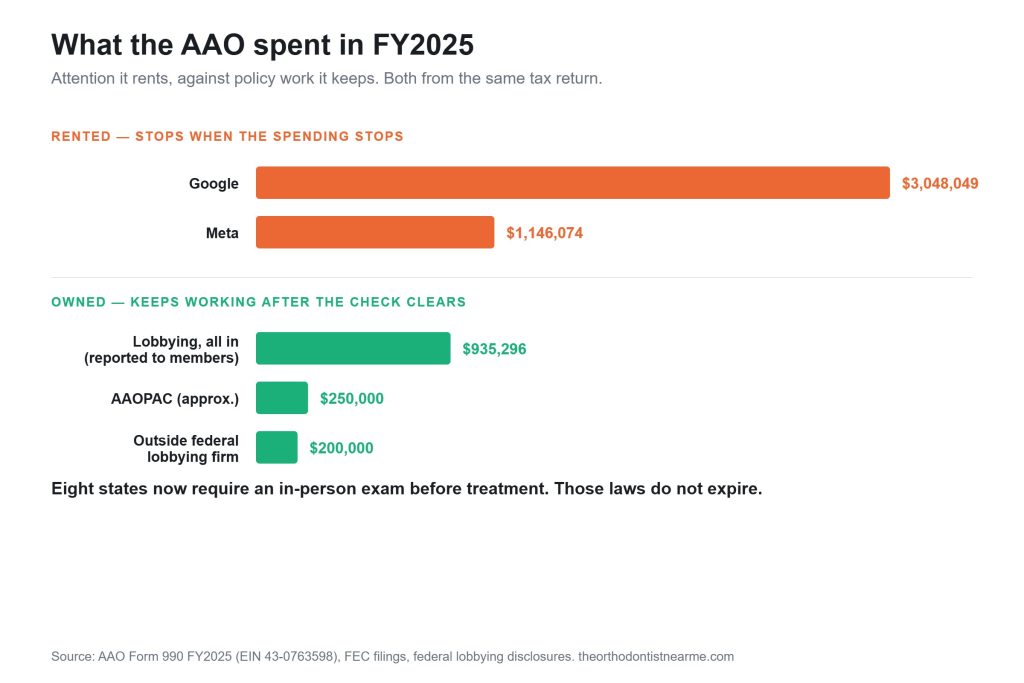
Eight states now require an in-person exam before treatment starts. That is the best money this profession has ever spent, and it is the budget we starve.
- Every active member pays a mandatory $600 assessment for consumer advertising. The budget is $5 million a year, locked in by resolution through 2029. Advocacy has no assessment at all.
- The AAO paid Google $3,048,049 last year. Its entire outside federal lobbying contract runs $200,000 a year.
- The ad traffic is rented. Before the paid campaign scaled, the consumer site drew about 10,000 visitors a month. Stop paying and it goes back.
- The eight in-person exam laws do not expire, cannot be taken down by a complaint, and protect every orthodontist in those states whether they are members or not.
- I think the budgets should trade places.
First, the disclosure: I run a directory of privately owned orthodontic practices. It overlaps with what the AAO’s locator does. Read the rest knowing that.
Second, the thing that set me off.
Last year the AAO paid Google $3,048,049. That is from its own tax return, where Google is listed as the single largest outside contractor, ahead of the company that builds the exhibit hall. Meta was $1,146,074.
In the same period, the AAO’s outside federal lobbying contract, held by one firm, ran $200,000 a year.
Google gets more in a month.
What the $600 actually buys
There is a line on every member’s bill that is not dues. $600, mandatory, called the Consumer Awareness Program assessment. The budget is $5 million a year and the House of Delegates locked that number in through fiscal 2029.
On the Form 990 it sits on line 24a, labeled “Consumer Ed. Campaign.” Last year, $4,251,137. That is about one dollar in five of everything the association spends. Google and Meta together came to $4,194,123, which is within $57,000 of the whole line.
So the assessment is, in practice, a programmatic media buy.
And it works. I want to be fair about that, because the easy version of this argument pretends it doesn’t.
The AAO published the proof itself in March 2018. February 2017: about 10,000 visitors to the consumer site that month. February 2018: over 700,000. They credited Google text ads, paid social, and a BuzzFeed video, and they were right to. Seventy times the traffic.
Now read the same sentence backwards. Ten thousand a month is what the site drew on its own. Everything above that line is rented, and rent is due again in June.
Last year’s numbers make it plainer. 676 million impressions, 16.7 million ad clicks, 15.4 million visitors. They bought more clicks than they had visitors.
Rented things get taken back
In 2021 SmileDirectClub complained to the National Advertising Division about the AAO’s “Happy Mouth Now” campaign. That was the flagship. Ten million views, two Gold ADDYs.
NAD recommended the AAO discontinue most of the implied claims. It upheld one of them. The AAO said it disagreed, complied, and pulled the ads.
An award-winning, member-funded campaign was switched off by an outside body in a matter of weeks, and the money that built it was gone.
What the other column bought
Eight states now require an in-person examination before orthodontic treatment can begin. Nevada, Florida, Illinois, Utah, Georgia, West Virginia, Oklahoma, Texas. Texas took effect last September.
Sit with what that is.
It does not stop working when the fiscal year closes. No platform can turn it off. No competitor can file a complaint and have it withdrawn in six weeks. It protects every orthodontist practicing in those states, including the ones who never paid a dollar of dues. And it will still be protecting them in 2040.
That is the single best return in the AAO’s filings and it is not close.
What it cost
Here is what the AAO spends on the whole advocacy effort, and I want these numbers precise because the sloppy version of this comparison is wrong.
| FY2025 | Amount |
|---|---|
| Consumer advertising (Form 990 line 24a) | $4,251,137 |
| Outside lobbying fees (line 11d) | $570,159 |
| What the AAO told members was non-deductible because it funds lobbying | $935,296 |
| AAOPAC, roughly, per year | $210,000 to $290,000 |
The $935,296 is the fairest figure because it captures in-house staff and overhead, not just outside firms. Add the PAC and the association’s total advocacy effort runs around $1.2 million a year.
One point two million dollars. Fifty states, a Congress, the FDA, and a Federal Trade Commission.
Against four and a quarter million for impressions.
The argument for the ads, made properly
The AAO’s case is real and it goes like this. A specialty this small is invisible. A patient who does not know that orthodontists exist as a distinct profession will never ask whether the person treating them is one. Awareness is upstream of everything, including the laws, because legislators are consumers too. And the same organization running the ads also won those eight states, so it is not as if one crowded out the other.
All of that is true. I am not going to pretend the campaign is worthless, because it isn’t.
Here is why I still think it is the wrong priority.
Advertising competes for share inside a category. Legislation decides who is allowed in the category at all.
Every serious threat to this profession right now gets settled in a hearing room, not in a mother’s Instagram feed. Who is permitted to own the practice and set the clinical quotas. Who may legally provide orthodontic treatment. Whether treatment can begin without anyone looking in the patient’s mouth. What insurers are required to cover, airway work included.
You cannot buy your way out of any of those with impressions. You can only write them into law, and once written they stay written.
The part that bothers me most
Three fights decide whether an independent orthodontist still has a business in ten years. Who is allowed to own the practice. Who is allowed to do orthodontics. And whether this specialty leads on airway or cedes it.
I went through the advocacy pages, the published issue list, the regulatory agenda, the state advocacy reports, and the federal lobbying filings. The AAO has no advocacy position on any of the three.
Ownership
Members have raised private equity consolidation in two consecutive annual policy surveys. The AAO logged it as a priority issue both times.
Its stated response, in the 2026 survey writeup: the AAO “is closely monitoring policy action on these topics.”
Further down the same page, on specialty advertising, the AAO says it “is renewing and expanding its engagement on this issue.”
Two verbs, one document. The California Dental Association sponsored actual legislation on ownership. The AAO’s education catalog offers a course called “The DSO Model: Why it Makes Economic Sense.”
Who is allowed to do orthodontics
Here the AAO does fight, and fights well, but only over a word.
It backs laws requiring any dentist who advertises as a “specialist” to have completed a CODA-accredited program of at least two years. It has worked that in twenty states, and members voted it the number one advocacy priority this year. Credit where it is due. That is real, sustained, effective work.
What the AAO does not have is any position on who may actually provide the treatment.
In December 2025 it published guidance for orthodontists who write treatment plans that general dentists then carry out. Its own words: “While the AAO does not take a formal position, it is important to highlight issues that merit careful review.”
And in 2021 the House of Delegates revised the Clinical Practice Guidelines so that they “encompass all licensed dental practitioners providing orthodontic care,” then sent them to all fifty state dental boards.
The association’s flagship clinical document, the one regulators actually read, is written on the assumption that non-specialists do orthodontics.
There may be a good reason for that. A trade association telling a state board who is permitted to perform a procedure is the kind of thing that ends up in front of the Federal Trade Commission, and dental boards have lost that fight before. That is my read, not something the AAO has said. But the effect is the same either way. The association will defend the title and not the work.
Airway
The AAO has published two white papers, the 2019 original and an update in April 2026. The update is restrictive. No evidence that any orthodontic intervention prevents sleep-disordered breathing. No treatment without a physician’s diagnosis and plan. Cone beam CT and cephalometric imaging “should not be used for screening, diagnosing” it.
Agree with that or not, it is a clinical document, and the specialty is openly split over it. The editor of the Journal of Clinical Orthodontics wrote this year that “there is no such thing as an ‘airway orthodontist.'” Others have pointed out the panel that wrote the update included no physicians.
What does not exist anywhere is airway advocacy. Nothing in OrthoFacts, nothing in the state agenda, nothing in the priorities. No position on who may diagnose, none on the boundary with sleep medicine, and none on medical billing, which is the part that decides whether any of this is viable in a practice.
So on the one airway question that is actually a policy question, the association is silent, and on the clinical one it has told members mostly what not to do.
I am not saying the AAO should be anti-corporate, or that every orthodontist should be doing airway work. I am saying that having no position on all three, while spending four million a year telling the public to see a specialist, is a strange set of priorities for an organization whose members keep asking who they will be working for in ten years.
So swap them
This is the part where I stop describing and start arguing. Here is what I think should happen.
The $600 should fund advocacy, and it should be locked in by resolution the way the ad budget is today. Five million dollars a year, guaranteed, not fighting for leftovers after everything else is funded.
Five million across fifty states is a hundred thousand dollars a state. In most state capitals that buys a genuine retained presence rather than a volunteer flying in once a year. Eight states took this long on roughly a million a year. Fund it properly and the map finishes.
Who may own a practice. Who may provide orthodontic treatment, not just who may use the word. And where this specialty stands on airway, including medical billing and the boundary with sleep medicine. Write them down, publish them, lobby them. A profession that will not say what it thinks about who owns it has already conceded the question.
Not zero. The campaign has value and a smaller buy still reaches people. But it should compete for general funds each year on its results, which is exactly the discipline every other line item faces and the only one with a guaranteed assessment does not.
Form 990 Part III asks an organization to list its programs and what each one spent. The AAO names professional advocacy as one of only three programs and leaves every expense box blank, every year. The ad campaign has its own line on the expense statement. Advocacy does not even have a number. Fix that first, because members cannot vote on a ratio they cannot see.
What I would want a delegate to ask
Not a hostile question. Just the one nobody seems to ask.
Why does the thing that evaporates every June have guaranteed funding, and the thing that lasts forever does not?
I have read the House of Delegates summaries. The consumer advertising assessment gets renewed in three-year blocks with no recorded debate. Nobody stands up and says the money should go somewhere else.
Somebody should.
If anyone from the AAO wants to answer any of this, I will print it in full, unedited, at the top of this article.
Earlier in this series: where the AAO’s money comes from now, and what it costs a company to be seen at Annual Session.
About this one
Sources are the AAO’s own published pages and program reports, IRS Form 990 filings (EIN 43-0763598), FEC filings for AAOPAC, federal lobbying disclosures, and BBB National Programs’ published NAD decision. All of it is public and all of it is linked.
This one is an argument, not just a tally. The facts are sourced. The conclusion is mine, and reasonable people in this profession will disagree with it. If you do, tell me and I will print that too.
If any of it is wrong, send me the source. I’ll correct it within a few business days and mark the correction clearly.
Next in this series
What the AAO Board Pays Itself.
In the meantime, see what one state just decided about who is allowed to own an orthodontic practice.