
MARPE: What Adult Palatal Expansion Actually Does
★ The short version
- MARPE works in adults more often than most people expect. The pooled success rate across studies is 92.5%.
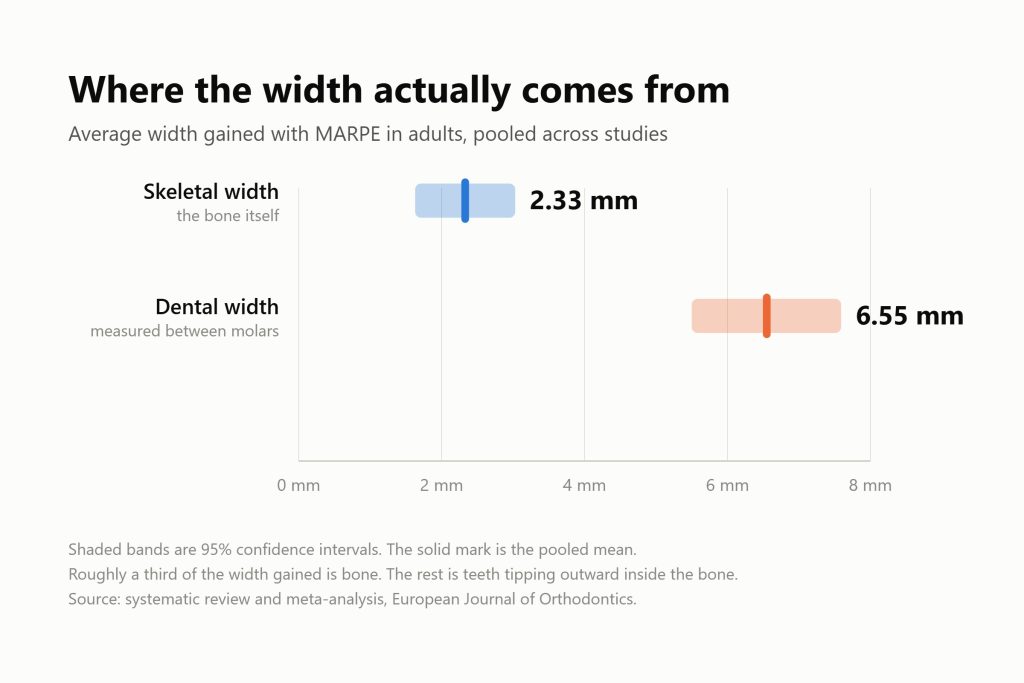
- But read what “success” means. Average skeletal width gained is 2.33 mm. Average dental width gained is 6.55 mm. Most of the width you see is teeth tipping outward, not bone separating.
- Age matters and is not the deciding factor. One review found 100% suture opening in patients 18 to 29, and 81% in patients 30 to 45. Every recorded failure was in a late-stage fused suture.
- Your birthday does not decide this. A CBCT of your midpalatal suture does.
- Expansion itself takes 20 to 126 days. The side effects are real and worth reading before you agree to it.
There is a question I get asked in some form nearly every week by adults, and the internet answers it badly in both directions.
Can a grown adult have their upper jaw widened without surgery?
Half the pages you will find say no, you are too old, the bone is fused, you need surgery. The other half say yes, absolutely, book now. Neither is honest, and the real answer is more useful than either.
Jaw expansion in adults is genuinely possible. It is also genuinely different from what happens in a child, and the difference is the part worth understanding before you sit in anybody’s chair.
What a MARPE expander actually is
MARPE stands for miniscrew-assisted rapid palatal expansion. Some practices call their version MSE, for maxillary skeletal expander. The difference between the two is mostly where the screws sit and how many there are, not what they are trying to do. Both are adult palatal expanders, and both exist because the version used on children stops working once you grow up.
A conventional palatal expander pushes against your teeth. In a child that is enough, because the seam running front to back along the roof of the mouth, the midpalatal suture, has not fused yet. Push on the teeth and the whole upper jaw splits and widens.
In an adult that seam has often fused. Push on the teeth and the teeth tip outward while the bone stays exactly where it was.
MARPE puts small screws through the roof of the mouth into the bone itself. The force goes into the skeleton rather than into the tooth roots. That is the entire idea, and it is a good one.
Does it work in adults?
Usually, yes.
A systematic review and meta-analysis in the European Journal of Orthodontics pooled the studies on MARPE in late adolescents and adults and put the success rate at 92.5%, with a confidence interval of 88.7% to 96.3%. Individual studies ranged from 80.65% to 100%.
For a procedure that a lot of clinicians still describe as not possible after adolescence, that is a striking number and it deserves to be said plainly.
The number that success rate hides
Now the part I would want to know if it were my mouth.
The same meta-analysis measured how much width was actually gained, and it separated the two kinds.
| What was measured | Average gain |
|---|---|
| Skeletal width, the bone itself | 2.33 mm (95% CI 1.63 to 3.03) |
| Dental width, measured between molars | 6.55 mm (95% CI 5.50 to 7.59) |
Read those two rows next to each other. A bit over a third of the width is bone moving. The rest is teeth tipping outward inside the bone.
That is not fraud and it is not failure. Some dental tipping is expected and often perfectly acceptable. But “the suture opened” and “you gained six millimetres of jaw” are two very different claims, and the second one is not what the evidence says.
The review also recorded, at statistical significance, increased dental tipping, decreased buccal bone thickness, decreased buccal alveolar height, and changes to the nasal soft tissue. Those are the trade-offs. A provider who does not raise them has not read the literature either.
Does age decide whether you are a candidate?
It influences it. It does not decide it.
A scoping review found 100% midpalatal suture opening in patients aged 18 to 29, and 81% in patients aged 30 to 45. Other studies put general efficacy nearer 80%.
Here is the finding that matters more than either number. Every failure recorded in that review happened in a patient whose suture was at a late stage of maturation.
Sutures do not fuse on a schedule. Two 35-year-olds can have completely different palates, and there are people in their forties with more open sutures than some people in their twenties.
Which is why the honest version of “am I a candidate” is not a number you can look up. It is a CBCT scan, read by someone who knows how to stage a midpalatal suture. Anyone who tells you whether MARPE will work on you without looking at that scan is guessing, whichever way they guess.
We went deeper into the staging and what it means in MARPE vs. SARPE.
How long does it take?
The active expansion phase in the pooled studies ran from 20 to 126 days. That is the turning, not the whole treatment.
After expansion stops, the opened suture has to fill in with new bone, and that takes months. One finding worth knowing: the research reports incomplete suture repair in most adult patients even 16 months after treatment. Adults heal that seam slowly and sometimes not fully.
What can go wrong
The honest list, from the published reviews rather than from a brochure:
- Buccal bone thickness reduction, meaning less bone on the cheek side of the roots
- Tooth inclination and buccal tipping, which is the trade-off discussed above
- Root resorption, though the evidence suggests less of it than with some alternatives
- Temporary reduction in pulp blood flow
- Inflammation or hyperplasia of the palatal mucosa around the screws
- Papillary recession, seen as mild in about 18% of patients at 18 months
- Skeletal relapse, with reported reductions of about 5.75% in nasal width and 19.75% at the lateral pterygoid plates
- Screw failure or the suture simply not separating, which is the failure mode that sends you to the surgical option
None of that makes MARPE a bad procedure. It makes it a real one. A conversation that includes this list is a conversation with someone who does this regularly.
What does MARPE cost?
It varies more than most orthodontic treatment, because the appliance, the CBCT, and the orthodontic treatment that follows expansion are often quoted separately, and because it is frequently part of a larger plan rather than a standalone procedure.
The number to ask for is the all-in figure: the scan, the appliance, the placement, the follow-up visits during expansion, the retention period, and whatever alignment happens afterward. A quote for the expander alone will understate what you actually pay.
Ask too what happens financially if the suture does not open and the plan changes. That is the question nobody thinks to ask up front and everybody wishes they had.
Who should be doing this
This is the part I feel strongest about.
MARPE puts skeletal anchorage into the palate and applies orthopedic force to an adult skull. It is not a device you order from a catalogue and hand to a patient.
Ask directly how many adult MARPE cases the provider has personally run, how they stage the suture before deciding, and what their plan is if it does not separate. Ask who reads the CBCT. Ask whether one clinician owns the case from diagnosis through retention, because a case handed between offices mid-expansion is a case where nobody is accountable for the result.
If the answers come easily, you are in the right chair. If they do not, keep looking. Our directory lets you filter for providers who offer this, and you can compare the surgical alternative in MARPE vs. jaw surgery.
The short answer
Yes, an adult jaw can often be widened without surgery, and more often than the old teaching allowed. The suture opens in the large majority of cases.
Just go in knowing that roughly a third of the width will be bone and the rest will be teeth, that your scan decides your candidacy rather than your age, and that the trade-offs are real enough to be worth a proper conversation before anybody places a screw.