
MARPE vs. SARPE: Which Way to Widen a Narrow Adult Jaw?
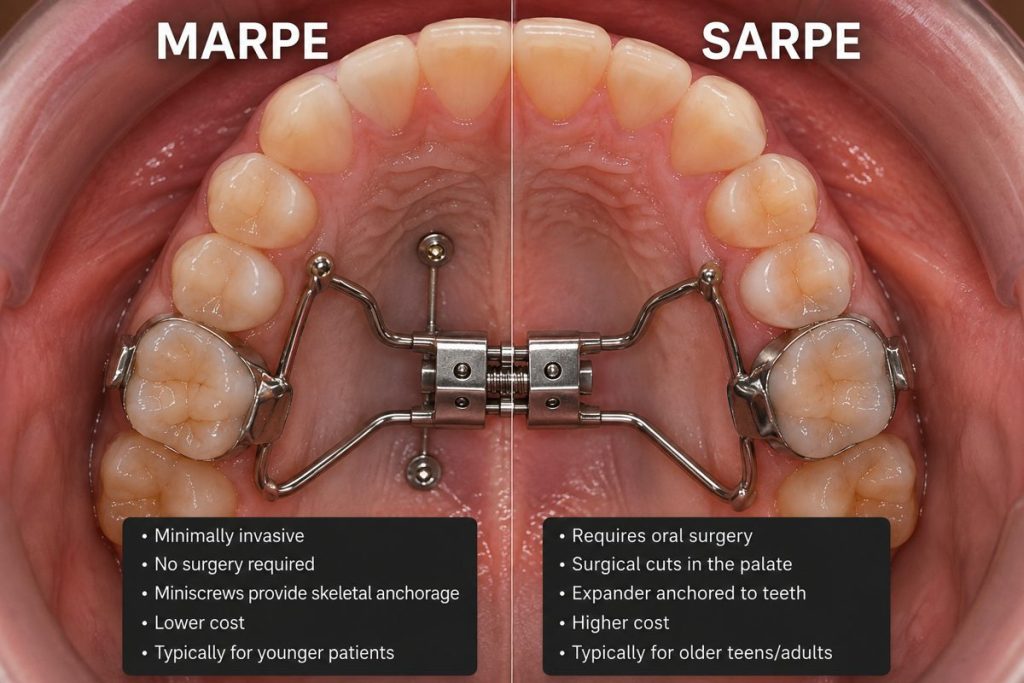
★ The short version
- Both MARPE and SARPE widen a narrow upper jaw by opening the seam down the middle of the palate. One does it with tiny bone screws, the other adds a small surgery to help the bone separate.
- The deciding factor is not your age. It is how fused that seam already is, which we check on a 3D scan.
- MARPE (little to no surgery) works well for most younger adults, with success around 84 to 88 percent under about 25. That number drops off through your thirties.
- SARPE (with surgery) is the more predictable choice once the seam has fused, usually in older adults or severe cases.
- Neither one is automatically better. The right call depends on your scan, how much width you need, and who is doing the planning.
A lot of adults come in already convinced they missed the window. They read somewhere that palate expanders are a kid thing, that once you are grown your only option for a narrow upper jaw is jaw surgery. Sometimes that is true. Often it is not.
If your upper jaw is too narrow, you usually feel it before you can name it. The bite feels off on one side. The teeth look crowded even after braces. There might be a crossbite that never fully went away. And when we talk about fixing it in an adult, two procedures come up: MARPE and SARPE. They sound almost the same and they are trying to do the same thing. How they get there is where they split.
What both procedures are actually trying to do
Down the middle of the roof of your mouth there is a seam called the midpalatal suture. When you are young, it is more like a zipper than a weld. That is why palate expanders work so easily on kids. You turn a screw, the two halves of the upper jaw drift apart, new bone fills in the gap, and the jaw is genuinely wider. Not tipped teeth, wider bone.
As you age, that seam starts to fuse. It does not happen on a schedule you can predict from a birthday. Some 30 year olds still have an open seam. Some 19 year olds are already fused tighter than you would expect. That single fact, how fused your suture is, drives almost everything about which procedure makes sense for you.
MARPE and SARPE are both answers to the same problem: how do you separate a seam that no longer wants to separate on its own.
MARPE, the less-invasive route
MARPE stands for Miniscrew-Assisted Rapid Palatal Expansion. You will also hear it called MSE or a maxillary skeletal expander. Instead of pushing on your teeth like the old-school expanders did, MARPE anchors to the bone itself with a few small titanium screws placed in the palate. Because the force goes straight into the bone rather than the teeth, it has a real shot at splitting the suture instead of just tipping teeth outward.
The appliance goes in, you turn it a set amount each day for a few weeks, and if the suture opens you will usually see a gap appear between your front teeth. That gap is a good sign. It means the two halves separated. It closes on its own afterward.
For most people MARPE means no operating room and no general anesthesia. That said, it is not always screws alone. Sometimes an oral surgeon places the miniscrews, especially when the palate is tricky, and in some cases a surgeon adds a few small cuts to help a stubborn suture start to release. That is still far less involved than full surgery, but it is worth knowing that the line between MARPE and SARPE is more of a spectrum than a hard wall. Active expansion runs about three to seven weeks, then a few months of holding it in place while new bone hardens in the gap.
SARPE, the surgical route
SARPE stands for Surgically-Assisted Rapid Palatal Expansion. Same goal, but here an oral surgeon makes small, precise cuts in the bone first to release the areas that are holding the jaw together. Once those buttresses are freed, an expander (traditionally anchored to the teeth, though newer versions can be bone-anchored) does the widening.
It sounds more dramatic than it usually is. The cuts are targeted, the procedure is common, and it is done under sedation or general anesthesia. But it is still surgery. There is a recovery period of a week or two before expansion even starts, and you are coordinating between your orthodontist and a surgeon.
The trade-off is predictability. When the suture is fully fused, trying to force it open without surgery tends to fail, and it can fail in ways you do not want. SARPE takes that resistance off the table by releasing the bone directly. For the right patient, that reliability is the whole point.
The real deciding factor is your suture, not your birthday
Here is the part most people get wrong. They ask, “Am I too old for MARPE?” The better question is, “What does my suture look like on a scan?”
We look at this on a 3D scan called a CBCT, and there is an actual staging system for it (orthodontists call it the Angelieri classification, stages A through E). Roughly:
- Stages A and B: the suture is still open. Strong MARPE candidate.
- Stage C: partially fused. MARPE is often still doable, but we look closely at how much solid bone is around those screws first.
- Stage D: mostly fused. This is where MARPE gets risky and SARPE starts to make more sense.
- Stage E: fully fused. SARPE territory.
Age correlates with these stages, but it does not decide them. That is why a good evaluation is not someone guessing from your age or eyeballing your teeth. It is a scan, a look at how thick the bone is where the screws would go, and an honest read of what your suture will actually do.
The numbers back this up. MARPE succeeds around 84 to 88 percent of the time in younger adults. In patients over 30 with an advanced, fused suture, some studies put the success rate closer to 20 percent. Same appliance, very different odds, and the difference is mostly that seam.
One thing to keep in mind about all of these numbers: MARPE is still a relatively new technique, and the figures are moving. As more orthodontists gain experience with it and more research comes in, the success rates, the age ranges, and the protocols keep getting refined. So treat these as the current picture, not the final word.
Side by side
| MARPE | SARPE | |
|---|---|---|
| What it is | Bone-anchored expander, little to no surgery | Expander plus a small surgery to release the bone |
| Best for | Younger adults, open to partially-fused suture (stages A to C) | Older adults or a fully-fused suture (stages D to E), or larger corrections |
| Anesthesia | Usually none; sometimes an oral surgeon places the screws | IV sedation or general anesthesia |
| Downtime | Minimal; some pressure the first days | About 1 to 2 weeks of surgical recovery before expansion |
| Timeline | ~3 to 7 weeks active, then 3 to 6 months holding | Recovery, then similar active and holding phases |
| Predictability in a fused suture | Lower; can fail if the seam will not open | Higher; the surgery removes the resistance |
| Cost | Lower; no surgeon or facility fees | Higher; adds surgeon, facility, and anesthesia |
| Main risks | Teeth tipping instead of bone splitting, loose screws, uneven expansion | Surgical risks: bleeding, infection, gum recession, numbness, uneven expansion |
The risks of MARPE
No procedure is risk-free, and anyone who tells you MARPE has none is not being straight with you. Here is the honest list:
- Teeth tip instead of the bone splitting. This is the big one. If the suture does not open, the force still goes somewhere, and that somewhere is your teeth leaning outward. You get the look of expansion without the real bone widening.
- The screws loosen or fail. They rely on solid bone. Thin or soft bone in the palate makes them less stable.
- Uneven expansion. One side can open more than the other.
- Soreness and pressure, especially in the first days of turning, and rarely a screw sitting too high near the nasal floor.
Most of these come back to planning. A screw placed into bone that is too thin, or a suture that was more fused than someone assumed, is where MARPE goes sideways. That is an evaluation problem more than an appliance problem.
The risks of SARPE
SARPE trades the suture uncertainty for surgical risk. Because it is an actual procedure, the list is different:
- Standard surgical risks: pain, swelling, bleeding, and infection.
- Numbness in the area from the nerves near the surgical site, usually temporary but occasionally lingering.
- Gum recession and some bone loss around the teeth in the expansion zone.
- Uneven expansion, reported in roughly 8 to 9 percent of cases, and relapse if the widening is not held properly afterward.
- The general downsides of surgery: anesthesia, recovery time, and higher cost.
None of this makes SARPE a bad option. It makes it a real surgery, which is exactly why it is reserved for the cases that need it rather than used as a default.
So which one is right for you
If your suture is still open or only partly fused and you do not need an enormous amount of width, MARPE is usually worth trying first. It is less invasive, less expensive, and when the suture cooperates it works beautifully.
If your scan shows a fully fused suture, or you need a large correction, or a MARPE attempt has already failed, SARPE is the more honest answer. Pushing harder on an appliance that cannot open the seam does not help you.
And there is a middle zone, stage C and D sutures, where reasonable orthodontists can look at the same scan and land in slightly different places. That is not a problem with the science. It is a judgment call, and it is exactly the kind of call you want an experienced person making.
Who should be doing this
This matters more than which procedure you pick. Palatal expansion in an adult is not a routine cleaning. It is skeletal work, and the planning is where it succeeds or fails.
Before you commit, ask:
Is a 3D CBCT scan part of the plan, or is someone recommending expansion off a quick look? Who is placing the screws and how many adult cases have they done? For SARPE, is there a real orthodontist-and-oral-surgeon team, not one person improvising both roles? What is the plan if the suture does not open the way we hope? A provider who can answer these clearly is the one you want.
Look for a board-certified orthodontist who does this kind of expansion regularly. Board certification through the American Board of Orthodontics is voluntary, and it tells you the person went well past the minimum. MARPE and SARPE both live at the intersection of orthodontics and, for SARPE, oral surgery. This is not the place for a general dentist working outside their lane or a self-described specialist without the training to back it up.
If you want the longer version of the surgery-versus-no-surgery question, we wrote a companion piece on MARPE vs. jaw surgery for adults. We also put together a guide on how to find a MARPE provider near you, including the badges we use to flag the ones who offer it. And when you are ready, you can search directly for a MARPE expander provider near you.
Not sure if your jaw can still be widened without surgery?
The only way to know is a proper look at your suture. Find an orthodontist who does adult palatal expansion and can scan, plan, and tell you straight.