
Aligners vs. Braces: What Actually Decides It
★ The short version
- I treat a lot of cases with aligners that plenty of orthodontists would only treat with braces. Case complexity is not what decides it for me.
- Two things decide it: whether your provider is genuinely comfortable running that case in aligners, and whether you will wear them full time.
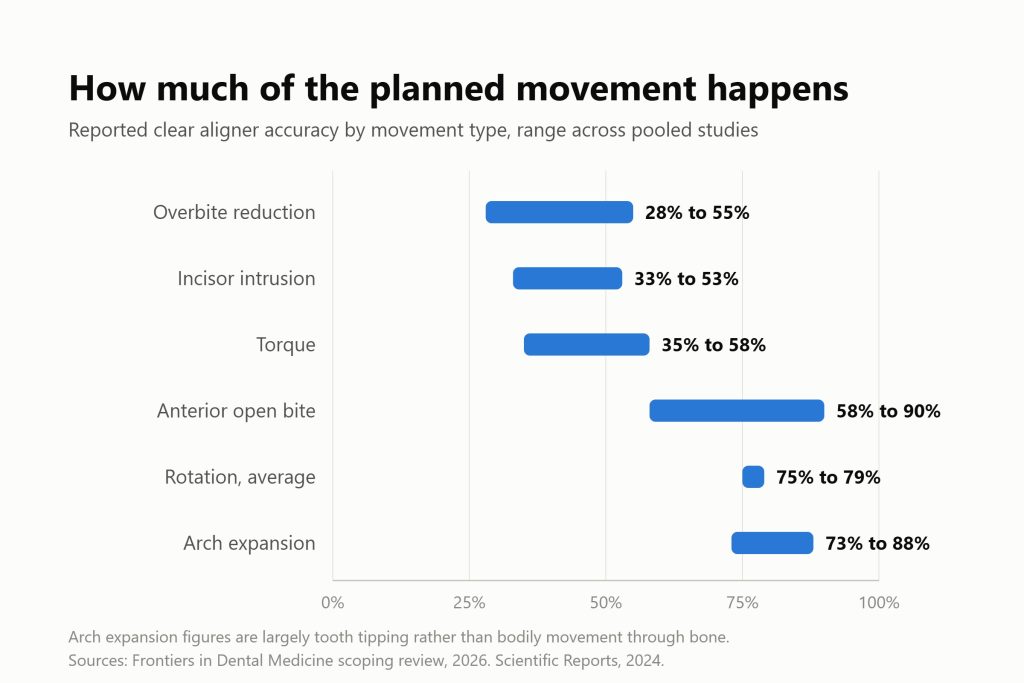
- The published accuracy numbers are real and they are unflattering. Torque runs 35% to 58%, incisor intrusion 33% to 53%. But those are averages across every operator in the studies, not a ceiling.
- In the pooled data, more than half of aligner cases needed a refinement round and 17.2% were switched to fixed appliances before finishing.
- Aligners still cannot move bone. A narrow jaw is a skeletal problem and no tray sequence fixes it.
Most articles on aligners vs. braces sort the question by case type. Mild crowding goes in plastic, hard cases go in brackets. Clean, tidy, and not how I actually practice.
I treat a lot of cases with aligners that plenty of good orthodontists would only treat with braces. Complexity is not the thing that stops me, because we have the planning and the team to run those cases properly.
So when somebody asks me which appliance is better, the honest answer has nothing to do with how crooked their teeth are. It comes down to two questions, and neither one is about the appliance.
The two questions that actually decide it
One. Is your provider genuinely comfortable treating this case with aligners?
Not whether they offer aligners. Whether they have run this kind of case, in plastic, enough times to know where the movement will fall short and how much to overbuild the plan to compensate.
That is a real and specific skill. It is not the same skill as bonding brackets and it is not conferred by buying a scanner.
Two. Are you going to wear them full time?
Twenty to twenty-two hours a day, every day, for the length of treatment. Braces do not ask you this question, because they are glued on. Aligners ask it every single day and they quietly fail if the answer is no.
Get honest answers to those two and the appliance choice mostly resolves itself. Get vague answers and no amount of case analysis will save the treatment.
Are braces better than Invisalign?
For raw control over the hardest movements, yes, and I would not argue with anyone who said so. Brackets are fixed to the tooth and they deliver force whether the patient is cooperating or not. That is a genuine advantage and no aligner system has replaced it.
What I would argue with is the leap from there to “so hard cases need braces.” Here is why.
I wanted to know whether my read matched the literature, so I went and read it. The accuracy studies ask a simple question: how much of the movement the software promised actually happened in the mouth?
A scoping review published this year pooled them.
| Movement | Reported aligner accuracy |
|---|---|
| Torque (rotating a tooth around its long axis) | 35% to 58% |
| Incisor intrusion | 33% to 53% |
| Overbite reduction | 28% to 55% |
| Anterior open bite closure | 58% to 90%, best under 3 mm |
| Arch expansion | 73% to 88%, but largely tipping |
Rotations got their own study. A 2024 paper in Scientific Reports put overall rotational predictability at 78.6% in the lower arch and 75.0% in the upper, then broke it down by tooth. Upper second molars came in at 60.7%. The lower first premolar was off by more than four degrees in 40% of cases, the worst result in the paper.
Round teeth with short crowns and nothing behind them are hard to grip with a piece of plastic. That part is physics and no amount of skill repeals it.
Here is what those numbers are not, though, and this is the part that usually gets skipped.
They are averages across every clinician in every included study. General dentists and orthodontists. First aligner case and thousandth. Plans that built in overcorrection and plans that took the default software output and shipped it.
An accuracy figure of 40% does not mean the movement is impossible. It means that on average, across everybody, you got 40% of what the plan drew. If you know that going in, you plan for more than you need and you finish the case. If you do not know it, you hand the patient a set of trays and hope.
That is the difference between the two providers in question one, and it is invisible from the outside.
The number worth hearing before you sign
More than half the aligner cases in the reviewed literature needed a refinement round, meaning a second set of trays after the first set did not finish. Patients often wore nearly twice as many trays as the original plan showed them.
And 17.2% of cases were converted to fixed appliances before completion. Roughly one in six started in aligners and ended in braces.
I do not read that as an indictment of aligners. Refinement is a normal part of aligner treatment and any provider who implies otherwise is selling. I read it as the cost of the two variables above being unmanaged: a case taken on by someone who had not run it before, or a patient who was not wearing them.
Either way, if you are choosing aligners specifically to avoid braces, one in six is a number you deserve to have before you sign rather than after. The review’s own recommendation, and I would sign my name to this one, is that complex cases should carry informed consent about possible conversion to fixed appliances from the very start.
Is Invisalign better than braces?
On everything you actually experience, yes, and the data here is not subtle.
A 2025 meta-analysis found aligner patients had roughly 15% less plaque, a mean difference of −0.437 on the plaque index. Gum inflammation was lower. Probing depths were about a third of a millimetre shallower. Pain was lower, with the widest gap early in treatment. Quality of life scored better at one week, at one month, and at the end of treatment.
One honest footnote on that last one. By twelve months the quality-of-life difference was no longer statistically significant. The advantage is real and it is front-loaded. People adapt to braces.
Can aligners fix a crossbite?
It depends on what is causing it, and this is the one place where case selection really is non-negotiable. No aligner sequence moves bone.
A tooth tipped into crossbite is frequently an aligner case. A narrow upper jaw is a skeletal problem, and widening it in a growing child means an expander. In a finished adult it can mean surgery.
Those two look similar in the mirror and they are not remotely the same problem. You cannot tell which one you have from photographs of your front teeth, which is the entire argument for getting a diagnosis before getting a quote. I went into that distinction at more length in orthodontist vs. dentist.
Do braces work faster than Invisalign?
For mild crowding the two land in a comparable stretch of time, and aligners are sometimes quicker. For bite correction, extraction cases, and significant rotation, the aligner estimate is the number most likely to move.
Read the refinement data as a timeline finding, not just an accuracy one. A case needing a second set of trays is a case running longer than the animation implied. Braces estimates slip too. They just do not usually double the appliance count.
If you get a month count at a first visit for either appliance, ask what it assumes and what would change it.
Aligners on a teenager
This is question two in its purest form.
The clinical side is usually manageable. Wear time is the whole risk. An appliance that comes out for lunch, for band practice, and for the school photo is an appliance that depends entirely on a fourteen-year-old’s follow-through.
Plenty of teenagers are excellent with aligners. Some are not, and a treatment that quietly underdelivers is worse than one that looked less appealing in the consult. An honest conversation about the specific kid in the chair beats any general rule about teenagers.
Also worth saying: some kids genuinely want braces, because of the colors. For them straight teeth are close to a side effect. Parents find that harder to believe than it deserves.
What about cost?
Closer than most people expect, and the spread inside each option is wider than the gap between them. Complexity drives the number far more than the appliance does.
Current figures live in the braces cost breakdown rather than here. If you are comparing aligner brands against each other rather than aligners against braces, that is a separate question, covered in Invisalign vs. Angel Aligner.
One caveat on all of these numbers
The evidence base is weaker than the confidence with which it gets quoted, mine included.
Most of these accuracy studies are retrospective and sit at the lower levels of the evidence hierarchy. Most looked at a single aligner system. The scoping review states plainly that adequately powered randomized trials are still needed and that its own overcorrection suggestions should not be treated as universal benchmarks.
So treat the table as the shape of the problem rather than a spec sheet.
How to actually decide
Four questions. The first two are the ones that matter.
How many cases like mine have you treated with aligners? Not how many aligner cases in total. Cases like yours. A provider who does this routinely will answer easily and will usually tell you where the hard part is before you ask.
Will I actually wear them twenty-two hours a day? Answer this one to yourself, honestly, rather than to the person selling you the treatment.
What happens if the first set of trays does not get us there? The answer should include refinement and it should include the possibility of switching to fixed appliances. A plan with no failure mode is a plan nobody has thought hard about.
Is my problem the teeth or the jaws? If nobody has taken the records that would answer this, the appliance conversation is premature.
The appliance matters less than almost every article on this subject implies. Who is running it, and whether you cooperate with it, matter more.