
Investor. Endorser. Award-Giver. When the AAO Does All Three.
The AAO owns equity in eight companies. It also decides which products carry its endorsement, and it hands out an annual innovation award. None of that is hidden. The disclosure is not consistent.
- In 2019 the House of Delegates took $3 million out of reserves to start a venture fund. The AAO now holds stakes in eight companies.
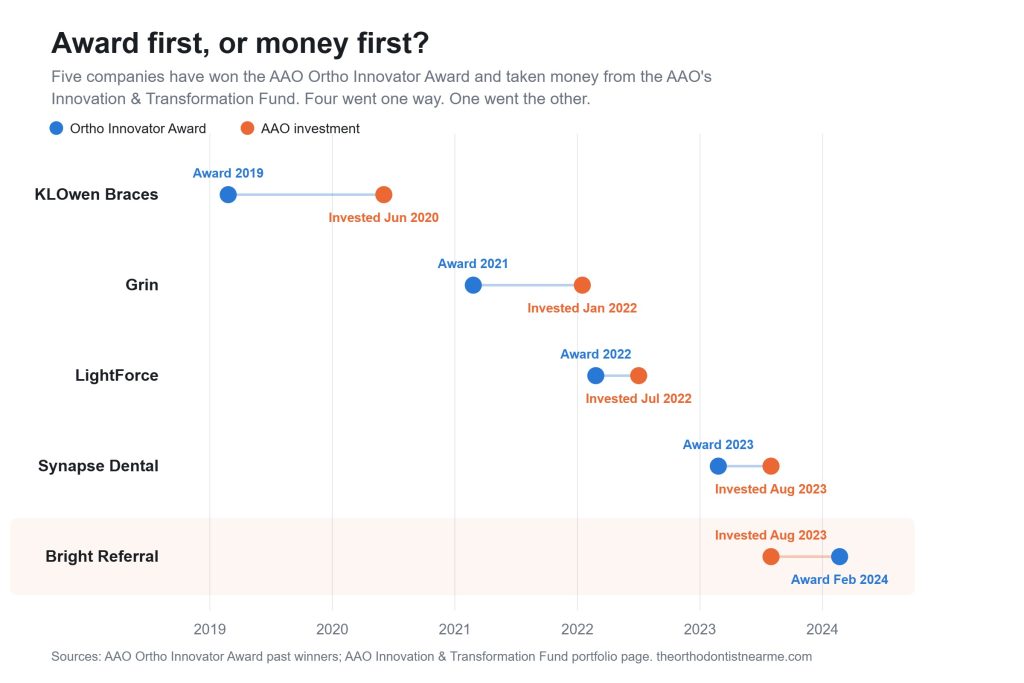
- Five of those eight have won the AAO’s own Ortho Innovator Award. In four of the five, the award came first and the investment followed. That is a scouting program working the way you would want it to.
- One runs the other direction. The AAO invested in Bright Referral in August 2023, then gave it the Ortho Innovator Award in February 2024. The award announcement does not mention that the AAO owns part of the company.
- When the AAO endorsed Orthazone, it disclosed its investment in the parent company. When it endorsed PhytoLight, made by a company the fund had already backed, it did not.
- The committee that makes these calls is described on the AAO’s website. Its members are not named.
I expected the AAO’s investment list to be hard to find. It isn’t. There is a page on their site that names all eight companies and the month each investment was made, and I want to say that up front, because most of what follows is built on documents the AAO published itself.
Here is the setup. In 2019 the House of Delegates approved taking $3 million out of reserves to start the Innovation and Transformation Fund. The stated purpose, in the AAO’s words, is “to support the goal of ‘Drive Transformation and Innovation'” and “to drive non-dues revenue.” The plan is a portfolio of up to ten companies with a three to five year exit window.
So the association buys equity in orthodontic startups.
I am not going to pretend to be upset about that part. I run a website. I have spent real money on software that did not work. A profession that puts nothing behind new technology gets whatever technology somebody else decides to build for it, and I would rather orthodontists have a seat at that table than not.
The question I care about is a different one. The AAO does not only invest. It also decides which products carry the AAO Endorsed logo, and it gives out an annual award for orthodontic innovation. Those are three separate jobs, and one organization is doing all of them.
Where the overlap is
Five of the eight portfolio companies have won the AAO Ortho Innovator Award.
That number looks worse than it is, and I want to be fair about it before I get to the part that bothers me.
| Company | Award | Investment |
|---|---|---|
| KLOwen Braces | 2019 | June 2020 |
| Grin | 2021 | January 2022 |
| LightForce | 2022 | July 2022 |
| Synapse Dental | 2023 | August 2023 |
| Bright Referral | February 2024 | August 2023 |
In four of those five, the award came first. A company wins recognition for a good idea, the AAO notices, the fund writes a check. That is not a conflict. That is an award functioning as deal flow, and if you were designing the thing on purpose you might build it exactly that way.
The fifth one runs backwards.
The AAO announced its investment in Bright Referral on September 20, 2023. Five months later, on February 21, 2024, it announced Bright Referral as the winner of the 2024 Ortho Innovator Award. I read that award announcement looking for a line disclosing that the association had money in the company. It is not there. The trade coverage does not mention it either, which makes sense, because the release they were working from did not.
I am not saying Bright Referral did not deserve it. I have no idea. That is sort of the point. When the judge owns a piece of one of the entrants, the reader needs to be told so they can decide for themselves, and here the reader was not told.
The AAO has already shown it knows how to disclose
This is the part that convinced me it was worth writing about.
In June 2021 the AAO endorsed Orthazone. The announcement says plainly that “the AAO Innovation and Transformation Fund has invested in Orthazone’s parent company, Azone,” and calls it the fund’s third investment. Somebody at the AAO looked at that release and decided the reader should know.
Good. That is how it should read.
In early 2024 the AAO endorsed PhytoLight, an antimicrobial system made by PhotoDynamic. PhotoDynamic was the very first company the fund invested in, in December 2019, for $100,000. I could not find any version of the PhytoLight endorsement that mentions the investment. Not the trade coverage, not the reprints the constituent societies ran.
One caveat on that, because I want to be accurate. I could not locate the PhytoLight endorsement on the AAO’s own website at all. What I read were the versions the Middle Atlantic and Great Lakes societies published, and the trade press writeup. If a fuller version exists somewhere behind a member login with the disclosure in it, I have not seen it, and I would print it.
Two endorsements, three years apart, same association, two different standards.
Who is in the room
The AAO does describe the body that runs the fund. From their site, the Business Development Committee is “comprised of four Trustees, and the following non-voting members: AAO CEO (ex-officio), AAO VP of Strategy and Innovation, AAO VP of Finance & Accounting and a Venture Capital Consultant.”
That is a reasonable structure. Trustees vote, staff advise, an outside professional does the diligence. The same page says every candidate is “thoroughly vetted by a venture capital consultant who reviews the candidate’s business model, business plan, financial projections, leadership team and risk.”
Two things I could not get past.
The members are not named. Not the trustees, not the venture capital consultant. The AAO’s public governance pages list the Board, the House of Delegates and the constituent groups, plus a council and committee roster that requires a member login. The Business Development Committee is not on the public index at all. The only person I could identify publicly is Dr. John Callahan, who described himself as its chair on a 2023 podcast.
And the same page that describes the Business Development Committee also says “Endorsements are vetted and approved by the Business Development Task Force.” Committee in one sentence, Task Force in the next. I do not know whether those are the same people wearing two labels, two overlapping groups, or a leftover name nobody updated. The AAO has not published anything that explains the relationship.
The gap in the conflict policy
The AAO publishes a Duality or Conflict of Interest Disclosure Form. It covers trustees, staff and volunteer leaders, and it asks them to disclose “all relationships which could potentially influence the way Participants carry out their AAO responsibilities, especially in matters related to their outside interests.”
Read that last part again. Outside interests. It is a form about what an individual owns.
Every conflict in this article belongs to the association, not to a person. The AAO owns the equity. The AAO grants the endorsement. The AAO gives the award. I went looking for an AAO policy that addresses institutional conflicts and could not find one. It may exist internally. It is not public.
And the returns
Six years in, there is no announced exit. No sale, no markup, no write-down, nothing.
The oldest two positions, PhotoDynamic and KLOwen, are now past the three to five year window the AAO set for itself. What happened to them has not been reported to members anywhere I can find.
There is a figure that gets quoted, and I want to be careful with it, because I think it is easy to misread. Dr. Callahan said in 2023 that the AAO “has increased non dues revenue from fund initiatives 120%.” That is non-dues revenue from fund initiatives, which appears to cover endorsements, member programs and similar. It is not a statement about what the equity portfolio is worth. I have not seen anyone claim that it is, but I have heard it repeated as though it were.
What I would want, and it is not much
None of this requires the AAO to stop investing. I would rather it kept investing. What I would want is boring, and mostly clerical.
If the fund owns a piece of a company, say so in the award release and in the endorsement release, the way the Orthazone release did. That is one sentence and it costs nothing.
Publish the members of the Business Development Committee on the public governance page, including the outside consultant, the same way the Board of Trustees is published. If the Task Force is a different body, say what it is and who sits on it.
Not another individual disclosure form. A short document that says what happens when a portfolio company applies for an endorsement or enters the award, and who recuses.
Members funded it out of reserves. Tell them what it is worth, what has exited and what has been written off, in the annual report to the House.
The AMA capitalized a separate company, Health2047, with its own CEO, staff and board, operating at arm’s length from the association. I have not found a source saying the AMA chose that structure for conflict reasons specifically, so I am not going to claim it did. But it is a model where the investing and the endorsing do not sit in the same building, and it is worth the House looking at.
The part I keep coming back to
The AAO published the fund page. The AAO published the award winners. The AAO published the Orthazone disclosure. Every fact in this article came from the AAO, or from trade coverage of AAO releases.
So this is not an organization trying to hide something.
It is an organization that has taken on a role it did not used to have, and has not yet built the disclosure habits that role requires. Those are very different problems, and the second one is fixable in an afternoon.
If you have not read it, the first article in this series covers where the AAO’s money actually comes from now, and why the trend line matters here.
About this series
This series is based on public IRS filings, AAO-published materials and primary company sources. When something is my calculation, interpretation or opinion, I will say so.
If I get a fact wrong, send me the source. I’ll correct it and mark the correction.
And if someone from the AAO wants to explain any of this, I will print it in full, unedited, at the top of this article.
I’d rather have the answer than the argument.
Next in this series
Pay to Play: What It Costs to Be Seen at the AAO.
In the meantime, see what one state just decided about who is allowed to own an orthodontic practice.