How Much Do Braces Cost in Dallas-Fort Worth? 2026 Local Price Guide
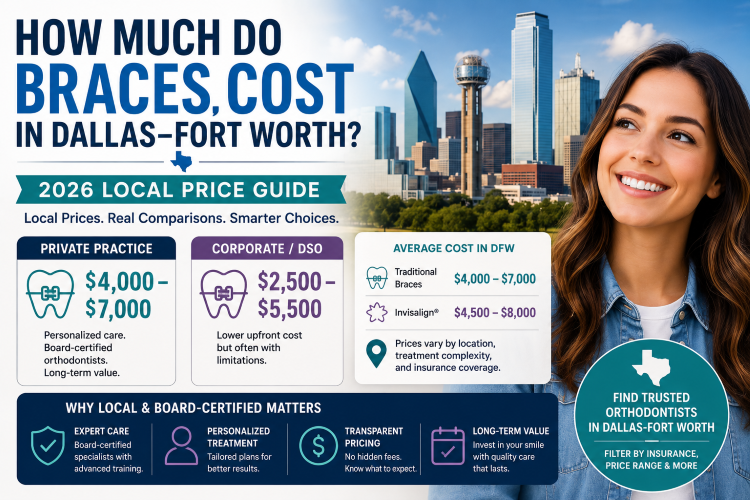
In the Dallas-Fort Worth area, traditional braces generally run about three thousand to seven thousand dollars, with most comprehensive cases landing around four to six thousand five hundred. Clear aligners and less visible options sit higher. What you actually pay depends on the type of appliance, how complex your case is, and which office you choose, and prices vary noticeably across the metro from Dallas to Fort Worth to the suburbs. This guide breaks down local ranges, what moves the price here, and how to compare DFW orthodontists.
Braces and Invisalign prices in DFW
Across Dallas-Fort Worth, traditional metal braces typically fall in the range of about three thousand to seven thousand dollars for a full course of treatment, with most comprehensive cases quoted somewhere between four thousand and six thousand five hundred. Clear aligners such as Invisalign usually sit a little higher, often in the four thousand to seven thousand five hundred range, and less common options like ceramic or lingual braces climb higher still. These are all-in figures meant to cover the whole treatment, not per-visit costs.
The important caveat is that these are ranges, not price tags. A DFW orthodontist cannot quote your real number until they have examined your teeth, because the fee tracks how much work your case actually needs. Treat any advertised flat price you see around the metro as a starting point for the conversation, and expect your written quote to reflect your specific bite.
How the type of braces changes the price
The appliance you choose is one of the biggest drivers of the total. Metal braces remain the most affordable and the most common, especially for kids and teens. Ceramic, tooth-colored braces cost more because the materials are pricier and designed to blend in. Clear aligners generally land at the higher end because of the custom manufacturing involved, and lingual braces, which mount behind the teeth, are usually the most expensive of all.
More expensive does not mean better for you. The right choice balances your budget, how visible you want treatment to be, and what your case actually requires. Plenty of DFW patients get an excellent result with standard metal braces, and a good orthodontist will tell you honestly when a lower-cost option would work just as well.
Worth knowing: Two offices a few miles apart in the metro, say one in Uptown Dallas and one in a suburb like Mesquite or Arlington, can quote noticeably different numbers for the same treatment. That gap usually reflects different overhead and rent, not different quality, which is exactly why getting more than one local quote pays off.
What moves the price across the metro
Three things move a DFW quote the most. The first and largest is case complexity: a minor correction costs far less than a full bite correction that involves moving many teeth or guiding jaw growth. The second is treatment length, which is tied to complexity, since a longer case means more adjustment visits built into the fee. The third is location within the metroplex, because rent and operating costs differ between central Dallas, Fort Worth, and fast-growing suburbs like Frisco, Plano, and Arlington.
That local variation is real money. It is common for families to find that widening the search by a few miles, or checking an office one suburb over, changes the quote meaningfully for the same treatment plan. Because DFW is spread out, comparing across a couple of nearby areas is one of the simplest ways to land on a fair price.
Why the office you pick matters
Dallas-Fort Worth has a mix of independently owned orthodontic practices and offices tied to larger corporate or dental service organization groups. Both can deliver good care, but pricing structures, financing, and how treatment decisions get made can differ between them. It is fair to ask an office whether it is privately owned or part of a group, and to understand who is actually planning and delivering your treatment.
Ownership is information, not a verdict. We do not think one model is automatically better than the other, but it is the kind of detail patients deserve to know before committing to a long course of care. Our guide on private versus corporate orthodontists explains why the distinction can matter, especially after a dentist referral.
How to compare DFW orthodontists
- Get written quotes from two or three practices, and compare what each fee includes, not just the headline number.
- Check offices in more than one part of the metro, since suburban and central prices can differ.
- Ask whether the first consultation is free, as many DFW practices offer it at no charge.
- Confirm whether retainers and follow-up visits are in the quote or billed separately.
- Ask about in-house monthly payment plans and their interest terms.
- Have each office verify your dental insurance benefits before you decide.
- Ask whether the practice is board certified and whether it is independently owned.
For a deeper look at how insurance changes your out-of-pocket total, see our guide on whether dental insurance covers braces and Invisalign.
Your next step
The most reliable way to find a fair price in Dallas-Fort Worth is to compare written quotes from a few local orthodontists side by side. It costs nothing but a little time, and in a metro this large the differences are often worth it.
Find and compare orthodontists across Dallas-Fort Worth, including which practices are board certified and independently owned.
Search orthodontists near me →This article is general information, not medical or financial advice. Costs vary by individual case and by office; always confirm pricing directly with a licensed orthodontist.