
How Long Do Braces Take? Realistic Timelines by Case Type
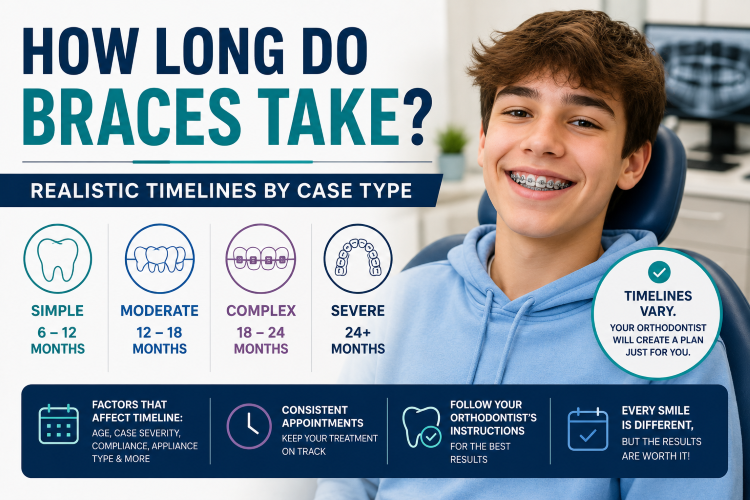
Most people wear braces somewhere between one and three years, with about two years being a common average. The real answer depends almost entirely on how much your teeth need to move. A minor fix can be done in well under a year, while a complex bite correction can run past two. This guide gives realistic timelines by case type, explains what actually speeds treatment up, and covers the part people forget: retainers afterward.
The average, and why it is a range
Ask an orthodontist how long braces take and the honest answer is a range, usually one to three years, centered somewhere around two. That is not vagueness. It reflects the fact that braces are not a fixed program you run for a set time. They are a process of moving teeth, and teeth move at a biological pace that only goes so fast. The more distance your teeth have to travel and the more your bite needs correcting, the longer the process takes.
This is why two people can start braces the same week and finish months apart. It is also why any promise of a guaranteed short timeline before an exam should be taken with caution. A real estimate comes after an orthodontist has looked at your teeth, your bite, and often your X-rays, and can see how far things actually need to move.
What moves the timeline
The biggest factor by far is the complexity of your case. Straightening a few mildly crowded teeth is a short job. Correcting a significant overbite, underbite, or crossbite, closing large gaps, or making room by moving many teeth is a longer one because there is simply more movement to accomplish. Age plays a smaller role too, since younger patients who are still growing sometimes respond a bit faster, though adults get excellent results and the difference is often modest.
Then there is the part you control. How consistently you keep your appointments, follow instructions, and, if you have removable aligners, wear them the required number of hours each day has a direct effect on the finish date. Broken brackets, missed visits, and aligners left in a drawer all add time. Your biology sets the floor on speed. Your habits decide whether you hit it.
Worth knowing: Treatment time is an estimate, not a contract. Even a well-planned case can run a few months longer or shorter than predicted, because teeth move at their own pace. A good orthodontist will update the estimate as they see how your teeth respond.
Realistic timelines by case type
Mild cases, such as slight crowding or a small gap with an otherwise healthy bite, often wrap up in roughly six to twelve months. These are the cases where lighter treatment can shine, and where you see change quickly.
Moderate cases, meaning noticeable crowding or spacing along with a mild-to-moderate bite issue, tend to fall in the eighteen-month to two-year window that most people picture when they think of braces. Complex cases, where a serious bite problem, significant crowding, or jaw alignment is involved, commonly run two years or more, and sometimes involve more than one stage of treatment. None of these ranges is a verdict on how well things will turn out. A longer case is not a worse case; it just has more work to do.
What actually speeds treatment up
- Keep every scheduled appointment, since each adjustment is what moves treatment forward.
- If you have clear aligners, wear them the full daily hours your orthodontist specifies.
- Protect your brackets and wires by avoiding hard and sticky foods that cause breakages.
- Wear any elastics or extra appliances exactly as directed, since skipping them stalls progress.
- Keep your teeth and gums clean, because inflamed gums can slow tooth movement.
- Report loose brackets or issues promptly instead of waiting for the next visit.
Notice what is not on that list: gadgets or shortcuts that promise to dramatically accelerate tooth movement. The dependable way to finish on time is consistency. The patients who beat their estimates are almost always the ones who simply follow the plan closely.
After braces: the retainer phase
Getting the braces off is not quite the end. Teeth have a natural tendency to drift back toward where they started, so retainers hold them in their new position while the surrounding bone and tissue settle. Skipping this phase is the most common way people undo years of work. Expect to wear a retainer full time for a stretch after treatment, then typically shift to nights only.
The honest long-term picture is that retention is ongoing. Many orthodontists now recommend wearing a retainer at night indefinitely to keep your results, since the drift tendency never fully disappears. It is a small nightly habit that protects a large investment.
Your next step
The only way to get a timeline for your teeth is an exam, and a good orthodontist will give you a realistic estimate along with the reasoning behind it. It is worth comparing a couple of offices, especially if the estimates or treatment plans differ. For help on cost and reading a quote, see our guide to what braces cost.
Find and compare orthodontists near you, including which practices are board certified and independently owned, and get a real estimate for your case.
Search orthodontists near me →This article is general information, not medical or dental advice. Treatment times vary by individual case; always confirm your estimate with a licensed orthodontist.