
Invisalign vs Angel Aligner: A Thorough 2026 Comparison
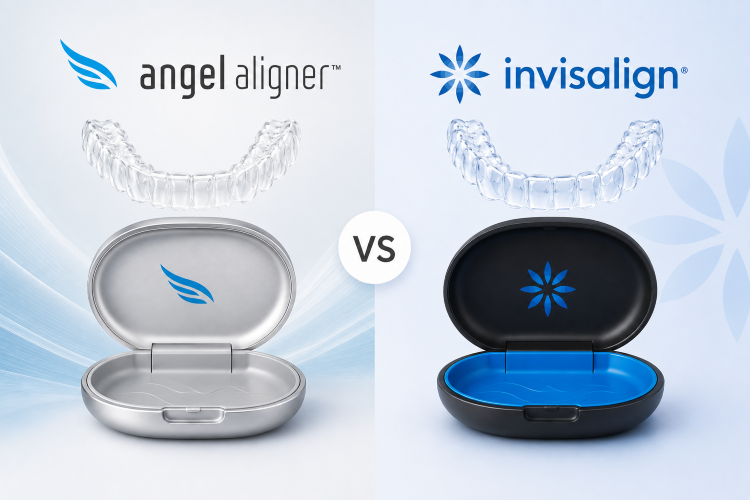
Invisalign and Angel Aligner are both doctor-prescribed clear aligner systems that move teeth with a series of removable, near-invisible trays. Invisalign is the older, far more advertised name in the US. Angel Aligner is a global leader, with more than two decades of experience and over a million cases treated worldwide, that is now expanding fast in the US, mainly through orthodontic specialists. The two differ in materials, built-in auxiliaries, and how each handles growing children. For most patients the bigger factor is the orthodontist, not the brand. This guide breaks down the real differences, including the perspective of Elate Orthodontics, one of the largest Angel Aligner providers in the country.
- Why you have heard of one and not the other
- The basics: who makes each one
- How both systems work
- The plastic: Angel’s 3-layer material explained
- Built-in auxiliaries: buttons, hooks, tongue spurs
- Expanding a child’s palate: the Invisalign route
- The Elate Orthodontics perspective
- Cost and treatment time
- How to choose
- Your next step
Why you have heard of one and not the other
Most people walk into a consultation already knowing the word Invisalign and having never heard of Angel Aligner. That is almost entirely about marketing, not medicine. Invisalign launched in the US in the late 1990s and has spent enormous sums building name recognition, including high-profile sponsorships. That spending made it a household name, and the cost of that advertising is built into the price patients pay.
Angel Aligner took a different path. It grew up as the dominant clear aligner brand across much of Asia, invested heavily in research and product development rather than consumer advertising, and only more recently turned its attention to the US. There is a second reason it stays under the radar with patients: as of 2026, Angel Aligner works in the US primarily with orthodontic specialists rather than general dentists. Its case validation, education, and clinical support are built around orthodontists. So if your family dentist mentions aligners, they are far more likely to name Invisalign simply because that is what general dental offices tend to carry. You often will not hear about Angel Aligner until you sit down with an actual orthodontist.
Worth knowing: Angel Aligner has over 20 years of clinical history and more than a million treated cases globally. It is not a startup or a mail-order aligner. It is a specialist-focused system that simply spent less on US advertising, and reaches patients mainly through orthodontists rather than general dentists.
The basics: who makes each one
Invisalign is made by Align Technology and launched in 1997. It was the first company to bring clear aligners to market and is still the most widely used and recognized brand in the United States. That head start means most providers have years of experience with its workflow, and the brand sits on one of the largest treated-case databases in the industry.
Angel Aligner is made by Angelalign Technology, founded in 2003 and publicly listed since 2021. It holds more than 150 patents across materials, manufacturing, and 3D printing, runs one of the largest automated aligner production facilities in Asia, and reinvests a significant share of revenue into research every year. In short: Invisalign is the established US incumbent, Angel Aligner is the global heavyweight growing its US presence through specialists.
How both systems work
Day to day, the patient experience is very similar. Both use a series of custom-made, removable, transparent trays. Each tray applies gentle pressure to move specific teeth a little, and you work through the series until your teeth reach the planned position.
With either system you typically wear the trays 20 to 22 hours a day, removing them only to eat, drink anything but water, and brush. You change to a new set roughly every one to two weeks and check in with your orthodontist periodically so they can confirm your teeth are tracking to plan. Both also use small attachments and auxiliaries to help with trickier movements, and this is one place the two genuinely diverge, as we will see below.
The plastic: Angel’s 3-layer material explained
The tray material is where a lot of the real engineering lives, even though patients never see it. The challenge every aligner maker faces is a tradeoff. A stiff plastic delivers strong force but can feel harsh and tends to lose its push quickly. A soft plastic is comfortable but may not move teeth efficiently. The goal is a material that is firm enough to move teeth predictably yet adaptable enough to hug them and stay comfortable.
A proprietary multilayer thermoplastic engineered for a gentle, continuous force and a snug fit. It is BPA-free, latex-free, and phthalate-free, and it is the most studied aligner material in the US market.
Built from three layers: a soft, elastic inner layer sandwiched between two firmer outer layers. The firm outer layers resist deflection and hold their force, while the soft middle layer adds give so the tray adapts to the teeth and stays comfortable.
That three-layer sandwich is the heart of Angel’s material pitch. A single-layer plastic has to be one thing at once, either firm or forgiving. By placing a soft elastomeric layer between two harder layers, the tray can resist losing its shape, which keeps the force consistent across the days you wear it, while the inner layer lets it flex enough to seat closely and avoid the harsh feel of a rigid tray. In practice the intended result is steady, sustained force with less of the sharp soreness that can come from stiffer single-layer designs. Independent laboratory studies of multilayer aligner sheets do generally show smoother, lower peak forces than single-layer sheets, which lines up with the comfort rationale, though exact behavior depends on the specific material and how it is used.
Built-in auxiliaries: buttons, hooks, tongue spurs
This is where Angel Aligner offers the widest toolkit, and it matters most for complex cases and for children. Traditional aligner treatment relies on bonding small composite attachments or metal buttons directly to the teeth so elastics can be hooked on. Those can pop off, distort the tray cutouts, and trigger emergency visits. Angel has engineered many of these helpers directly into the aligner itself.
- angelButton. An elastic attachment point built into the tray rather than bonded to the tooth. It can be placed at multiple points on a tooth, allowing elastics to pull from many directions and even apply force across a whole quadrant or arch. Because it is part of the aligner, there is little need to bond separate buttons, which means fewer broken attachments and fewer emergencies.
- angelHook. An integrated hook that lets the orthodontist attach elastics or even external appliances like a facemask directly to the aligner, without bonding partial braces. This opens up treatment of skeletal bite problems, including certain Class III cases, that used to require separate hardware.
- Tongue tamers / tongue spurs. Small plastic spurs built into the aligner that gently discourage tongue thrusting and low tongue posture. They are present only while the aligner is worn, and they help address the habits that can undo orthodontic results, especially in children.
- Bite turbos, eruption guides, and mandibular advancement. A range of integrated features for opening bites, guiding incoming permanent teeth, and advancing the lower jaw, particularly within Angel’s children’s system.
Invisalign uses attachments and elastics too, and treats a wide range of cases very capably. The distinction is that Angel has integrated more of these auxiliaries into the tray itself, which can mean fewer bonded parts in the mouth and a smoother experience for cases that need a lot of help.
Expanding a child’s palate: the Invisalign route
For younger children, treatment is sometimes less about straightening teeth and more about creating room. When a child’s upper jaw is too narrow, the palate needs to be widened so adult teeth have space and the bite develops properly. The old way was a metal expander cemented to the teeth and turned with a key.
The Invisalign Palatal Expander System is a removable, 3D-printed alternative. After an iTero digital scan, the child receives a series of custom-printed expanders, each slightly wider than the last, that gradually widen the upper jaw with gentle, steady pressure. Once the target width is reached, 3D-printed holders are worn and swapped every few weeks to stabilize the result. Because it is removable and has no metal or screws, kids can take it out to brush, floss, and eat normally, which tends to mean better hygiene and fewer unplanned visits. It is designed for growing children whose jaws are still developing.
This is a good example of why neither brand is simply better. Each company has built specialized tools for different clinical situations, and a strong orthodontist chooses the right tool for the case in front of them rather than forcing every patient into one system.
The Elate Orthodontics perspective
Elate Orthodontics is one of the largest Angel Aligner providers in the country, so we treat a high volume of cases with the system and have a close, hands-on view of how it performs. In our experience, the combination of the three-layer material and the integrated auxiliaries gives us excellent day-to-day control of tooth movement, and we have found cases often track closely to the digital plan. The built-in buttons and hooks in particular cut down on bonded attachments coming loose, which means fewer emergency visits and a smoother experience for our patients.
None of that makes Angel Aligner the right answer for everyone. It reflects what we see in our practice with the cases we treat, and clinical results always depend on the individual patient and consistent wear. We share it as the honest view of a high-volume provider, not as a claim that one brand wins for every smile. A different orthodontist with deep Invisalign experience could just as reasonably prefer that system, and be right for their patients.
Cost and treatment time
In the United States, both systems generally land in the same broad range of roughly $3,000 to $9,000, depending on case complexity, treatment length, your provider’s expertise, and where you live. Insurance and financing options tend to be similar for both.
Angel Aligner is often priced below Invisalign for a comparable plan, in part because it does not carry the same heavy advertising budget and brand premium. How much you actually save depends entirely on the individual practice, so treat any percentage claims as a starting point for your own written quote, not a guarantee. On timeline, both are similar and case-dependent: minor corrections around 3 to 6 months, mild to moderate cases 6 to 12 months, and complex cases 12 to 24 months. Your orthodontist gives a real estimate only after a scan and treatment plan.
A note on marketing claims: You will see lines like “up to 30% faster” or “up to 20% cheaper.” These come from brands and the practices selling them, not from independent head-to-head studies. Treat them as questions to ask, not facts to assume.
How to choose
Here is the honest truth: for most patients, the brand matters less than the orthodontist holding it. The same case can go beautifully or poorly with either system depending on your provider’s skill and how consistently you wear your trays. So rather than fixating on Invisalign versus Angel, trust an experienced orthodontist to recommend what gives you the best outcome. This is especially true in privately owned practices, where the orthodontist is free to choose whichever system fits your case, instead of defaulting to whatever a corporate group has standardized on.
That is exactly why it pays to know who owns the practice before you commit. A privately owned office and a corporate or DSO-owned chain can differ in how much freedom your provider has, whether you see the same orthodontist each visit, and how pricing is set. Most directories do not show ownership at all. OrthodontistNearMe labels each practice as privately owned or corporate owned, so you can factor that in before you ever sit in the chair.
Your next step
Both Invisalign and Angel Aligner can deliver excellent results in the right hands. Rather than picking a brand first, find an experienced orthodontist, check who owns the practice, get a real treatment plan, and let the clinical recommendation guide the system. The brand on the box matters far less than the person managing your smile for the next year or two.
Find an orthodontist near you, see who is privately owned vs corporate, and compare practices before you commit to any aligner system.
Search orthodontists near me →Are you an orthodontist? Add your practice to the directory →
This article is general information, not medical advice. Costs, features, and product availability change over time and vary by practice. Clinical observations reflect the experience of the providers cited and may not apply to your case. Verify details with a licensed orthodontist.