We Announced Our Directory to Orthodontists. 315 Private Practices Signed Themselves Up.
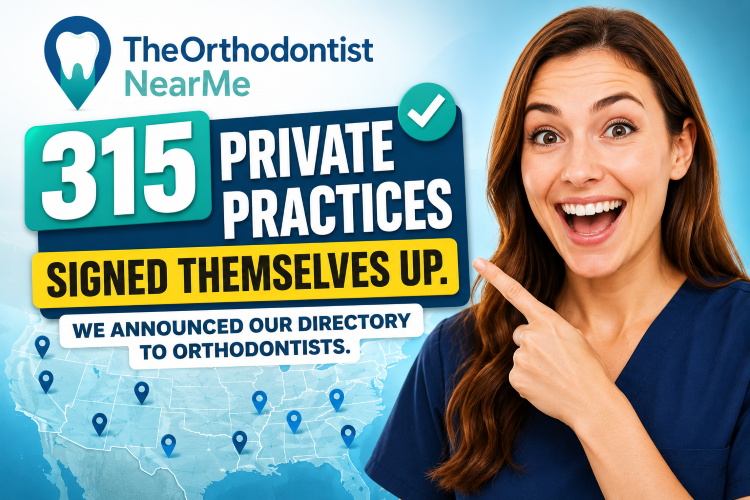
In late May we opened self-registration on a directory built around one idea no other listing site surfaces: whether an orthodontic practice is privately owned or part of a corporate or DSO group. Then we announced it to the orthodontic community, and the response was immediate. 315 privately owned practices added themselves, with a surge the moment word reached doctors. We did not import a single one of them. Every one is an orthodontist who heard about the directory and chose to raise their hand. The energy behind that response is the clearest signal yet that ownership transparency is not a niche idea. It is information the profession has been waiting for.
Every directory you have ever used can tell you where an orthodontist is, what hours they keep, and what other patients rated them. None of them can tell you who owns the practice. Whether the doctor across the chair runs their own office or works inside a corporate or dental support organization (DSO) group is, for almost every patient, invisible. It does not appear on Google, on Yelp, or even in the American Association of Orthodontists’ own member directory.
We built The Orthodontist Near Me to surface that one fact, plus a few others patients quietly care about: board certification, Medicaid acceptance, and weekend availability. Corporate and DSO locations are added from public records. Privately owned practices are different. They have to come to the site and register themselves. That design choice turned out to be the whole experiment. If private owners did not care about being named as private, nothing would happen. Here is what happened instead.
315 sign-ups, and a surge the week we announced
And the excitement was immediate. The moment the directory was announced to the orthodontic community in early June, sign-ups exploded. More than 200 private practices registered in a single week, then doctors kept telling other doctors and the wave rolled on. This was not a slow trickle or a bulk upload. It was a community reacting in real time to something it had clearly been waiting for. Look at the spike for yourself.
This was not one city or one state
If the response had come entirely from one metro, it would be easy to dismiss as a local fluke. It did not. Private owners registered from across the country, with Texas and California leading and strong showings from Florida, Virginia, and the Carolinas. The geographic spread is the second signal: independent orthodontists everywhere, not in one pocket, want patients to be able to find them and know how their practice is structured.
Every one of the 315 was privately owned
Here is a detail worth pausing on: not one of the 315 sign-ups was a corporate or DSO practice. Every single registration came from a privately owned office. That is by design. The directory only lets practices self-register, and the doctors who showed up to do it were independent owners, eager to be named as exactly what they are.
So how does the directory have corporate and DSO listings at all? We add those ourselves, from public sources. A corporate location’s name, address, and ownership are matters of public record, so we compile them rather than wait for a self-submission that, given the structure of those groups, would rarely come. The contrast is the point. When given a voluntary, free way to be identified, hundreds of independent practices rushed to take it. That enthusiasm is not something you can manufacture, and it is not something the public-records side of the directory can replicate.
What the self-registered practices looked like
The most striking pattern is in the practices themselves. Among the private practices that reported their certification status, the overwhelming majority listed a board-certified orthodontist. These are exactly the practices that have something to be transparent about, and they treated the directory as a place to prove it rather than a place to hide.
A note on the numbers: these rates are calculated only among the private practices that filled in each field, so they describe the practices that chose to report, not a national census of every orthodontist. The 315 figure counts privately owned practices that self-registered between May 21 and June 22, 2026. Corporate and DSO listings, which are added from public records rather than self-registered, are excluded from every figure on this page.
The reaction: gratitude, ideas, and some real pushback
Numbers were only half the story. The other half came in our inbox. Doctors reached out to thank us, often describing the same frustration in different words: their patients already ask who owns the practice and who is actually making the clinical decisions, and until now they had nowhere neutral to point them. A directory that simply states ownership as a fact gave them an answer.
Several went further and sent ideas. They suggested new fields, ways to make listings more useful, and details they felt patients deserved to see. Some of those suggestions are already shaping what we build next, which is exactly the kind of collaboration we hoped for when we started.
Not all of it was praise. Some doctors on the corporate and DSO side pushed back, and their concern deserves a straight answer rather than a dodge. They worry that drawing a line between private and corporate wedges the profession and implies that one model delivers better care than the other.
Here is where we stand, and we will keep saying it plainly: ownership is information, not a verdict. Excellent orthodontists practice inside corporate and DSO groups, and patients are well served by many of them. We are not ranking models. We believe patients have a right to know how a practice is structured, the same way they have a right to know whether a doctor is board certified or whether their insurance is accepted. What they do with that information is entirely up to them.
Transparency has to cut both ways to be fair, so it does. Every practice in the directory, corporate or private, can claim its listing and add its own description. We would rather give each practice the chance to speak for itself than let a single label carry the entire story.
What 315 sign-ups actually proves
One month of data does not settle a debate about how dentistry should be organized, and we are not claiming it does. What it does prove is narrower and, we think, more useful: when you give independent orthodontists a neutral place to be identified as independent, hundreds of them take it within weeks, from every corner of the country, and most of them turn out to be board certified. The demand for this information was not theoretical. It was sitting there, waiting for a place to land.
We are still early. 315 practices is a strong start and a long way from finished, and the directory grows every week. But the first month answered the only question that mattered at launch. Does ownership transparency matter to the people who actually provide the care? Three hundred and fifteen times over, the answer was yes.
Run a privately owned orthodontic practice? Add yourself to the directory. Listing is free, and you control your own information.
Add your practice →Looking for care? Search orthodontists near you and see ownership, board certification, and more before you book.
Figures on this page reflect privately owned practices that self-registered on The Orthodontist Near Me between May 21 and June 22, 2026, and describe the practices that chose to report each detail. They are not a national census of all orthodontists. Ownership labels are presented as information, not as a judgment of care quality.